Translate

Showing posts sorted by relevance for query ENNEAGRAM. Sort by date Show all posts

Tuesday, April 28, 2020

WHY THE ENNEAGRAM IS A DANGEROUS NEW AGE TOOL

WHY THE ENNEAGRAM IS A 
DANGEROUS NEW AGE TOOL 
Marcia Montenegro of ChristianAnswersForTheNewAge.com and Don Veinot of MidwestOutreach.org expose the shocking hidden dangers of the Enneagram in their new book, "Richard Rohr and the Enneagram Secret," available at EnneagramSecret.com
INTERVIEWED BY DOREEN VIRTUE, EX-NEW-AGER, CHRISTIAN CONVERT
SEE OUR PREVIOUS POSTS:
https://ratherexposethem.blogspot.com/search?q=ENNEAGRAM

AND:
Passion Conference Louie Giglio Gives Thumbs Up to Enneagram—Could Influence Scores of Young Evangelicals
SEE: https://www.lighthousetrailsresearch.com/newsletters/2020/newsletter20200512.htm; republished below in full unedited for informational, educational and research purposes:
Louie Giglio is an extremely popular megachurch pastor and author as well as the founder and leader of the Passion conferences, which have drawn in hundreds of thousands of mostly young people since 1997.(1) On the week of March 16th, Giglio (a Calvinist) was a guest on emergent social-justice “Gospel” advocate Ian Morgan Cron’s Enneagram podcast. A week later, part 2 of the interview took place.
While it of no great surprise that Giglio (who has shown himself to be part of the ecumenical, “new” spirituality in more ways than one(2)) would form an attachment to Morgan Cron’s Enneagram, it is most unfortunate: because of Giglio’s vast following, the Enneagram has now received a substantial thumbs up in the evangelical world, especially among young evangelicals. So not only are Giglio’s followers being influenced by Calvinism and the New Spirituality, they are also being led into New Age-rooted practices.
For those who are unfamiliar with the Enneagram, Lighthouse Trails released a booklet in October of 2019 titled The Enneagram—An Enlightening Tool or an Enticing Deception?. Below are the contents of the booklet (written by Lois Putnam and the Editors at Lighthouse Trails):

The Enneagram—An Enlightening Tool and an Enticing Deception?

Today, there is an increasing amount of interest by Christians in the Enneagram, a nine-pointed diagram used to determine personality traits and character tendencies. While it may seem harmless and nothing more than a useful tool, the Enneagram is a seducing lure to deception and an example of what the Bible refers to as “the wiles of the Devil.” In this booklet, we hope to show how this tool is drawing participants away from biblical truth and in an enticing but dangerous direction.
A book titled The Wisdom of the Enneagram by Don Riso and Russ Hudson describes the Enneagram, stating:
The Enneagram . . . is a development of modern psychology that has roots in spiritual wisdom from many different ancient traditions. 1
The Enneagram Institute, a go-to website for information on the Enneagram, says:
The Enneagram . . . [is] one of the most powerful and insightful tools for understanding ourselves and others. At its core, the Enneagram helps us to see ourselves at a deeper, more objective level and can be of invaluable assistance on our path to self-knowledge.2
A 2017 Religion News Service article states:
In 1990, Franciscan Fr. Richard Rohr effectively Christianized the [Enneagram] system for Americans when he published “The Enneagram: A Christian Perspective” in English. This sparked a growing interest that slowly crept into church pulpits and small groups. In 2016, Christianity Today published “An Evangelical’s Guide to the Enneagram” after InterVarsity Press became the first evangelical publisher to release a book on the topic.3
While the Enneagram’s popularity within the Christian church has continued to grow, especially among millennials, there have been those in the church who have voiced their concerns about the Enneagram. Martin and Deidre Bobgan, who have studied psychology from a biblical perspective for many years, say this about the Enneagram:
Although the Enneagram is purported to be an ancient spiritual tradition, it is relatively new to the Western world. George Ivanovitch Gurdjieff, who brought the Enneagram to Europe in the 1920s, claimed it originated about 2500 years ago in a Babylonian wisdom school. He taught that each person is born with a “planetary body type” with certain physical and psychological traits. He believed that a person’s physical and psychological characteristics are related to a dominant endocrine gland and to planetary influences on that gland. This implicates the Enneagram with Babylonian astrology, since those characteristics would be signified by a point on the Enneagram.4
Apologist and author Mike Oppenheimer says this about the Enneagram:
Enneagram claims to be an entry point for deep personal healing and renewal. Enneagram is a psychological and spiritual system for a higher consciousness. We are told it will help us understand the personality types and the differences in each other which should reduce unnecessary conflicts (transforming one into a more tolerant person). We can transform our habits by being our own observer in how we think and go from unconscious behavior to conscious behavior. This is done through a series of probing questions called a Personality Profile questionnaire where one learns what his or her type is. . . . The nine lines comprise a perfect triangle and a twisted hexagon contained within a circle. This is a New Age-type mandala, a mystical gateway to personality classification. The drawing is based upon a belief in the mystical properties of the numbers 7 and 3. 5

Richard Rohr’s Role

At the very epicenter of today’s Enneagram movement is Franciscan priest Father Richard Rohr, founder of the Center for Action and Contemplation (CAC). Rohr’s website states:
Seven of the nine Enneagram types are associated with the “capital” or “deadly” sins which originated with the Desert Fathers. But it was not until the late 1960s that Oscar Ichazo began teaching the Enneagram as we know it today. From Ichazo’s school in South America, a group of Jesuits learned the system and brought it back with them to the United States. Richard Rohr learned about the Enneagram from this group and was one of the first people to publish a book about it in English.
The Enneagram gained popularity as a tool within spiritual direction.* Today it is widely taught as a way of understanding personality, addiction, relationships, and vocation.6 (emphasis added)
After Rohr learned about the Enneagram in the 1970s, he shared his Enneagram teaching on ten tapes, later writing his now classic best-selling book, Discovering the Enneagram: An Ancient Tool for a New Spiritual Journey (now titled The Enneagram: A Christian Perspective).
In Rohr’s book, he explains that the underlying premise behind the Enneagram is that each person has a “true self and a “false self,” and with the help of the Enneagram, we can identify our true selves, and thus having identified it, we can now be spiritually transformed to live in that true self. Rohr explains:
[Co-author] Andreas Ebert and I again offer the Enneagram as a very ancient Christian tool for the discernment of spirits, the struggle with our capital sin, our “false self,” and the encounter with our True Self in God.7
When Rohr, who is an outspoken panentheist, says “True Self in God,” he is referring to his belief that the true self is the God within every human being. In echoing the Catholic mystics Thomas Merton and Henri Nouwen, Rohr advocates the concept of dharmakaya. Rohr states:
God’s hope for humanity is that one day we will all recognize that the divine dwelling place is all of creation. Christ comes again whenever we see that matter and spirit co-exist. This truly deserves to be called good news.8 (emphasis added)
To further understand what Rohr means when he says, “the divine [God] dwelling place is all of creation,” we need to understand his views about Jesus Christ. In an article on Rohr’s website titled, “The Cosmic Christ,” he says that Christ is more of an energy than a personal being:
Christ is not Jesus’ last name, but the title of his historical and cosmic purpose. Jesus presents himself as the “Anointed” or Christened One who was human and divine united in one human body—as our model and exemplar. . . . This Christ is much bigger and older than either Jesus of Nazareth or the Christian religion, because the Christ is whenever the material and the divine co-exist—which is always and everywhere. . . . The coming of the Cosmic Christ is not the same as the growth of the Christian religion. It is the unification of all things.9
For Rohr, Christ and humanity are not separate because Christ is not a person (or God come in the flesh to save man from his sins) but is an energy that exists in everyone and everything. Man’s only problem isn’t that he is sinful; rather, it is that he doesn’t realize he already has divinity within him. This is where the Enneagram comes in, for according to Rohr the Enneagram is a “key to self-knowledge,”10 and the goal for using the Enneagram is “an awakening of true self-love [i.e., the divinity within].”11

Rohr’s Enneagram Disciples

Some of Richard Rohr’s most popular “disciples” who carry on his Enneagram teachings include Ian Morgan Cron, Suzanne Stabile, and Chris and Phileena Heuertz (though countless others have been influenced by Rohr). Since each of these people has written Enneagram books and are key presenters and teachers of Enneagram programs, let us examine them to further understand the Enneagram.

Ian Morgan Cron’s Road to Self

Episcopal priest Ian Morgan Cron is a best-selling author and psychotherapist. He wrote the best-selling book (co-authored by Suzanne Stabile), The Road Back to You: An Enneagram Journey to Self-Discovery (published by InterVarsity Press). In chapter one, Cron relates how as a grad student, he found Rohr’s Enneagram book at a conservative seminary retreat. Upon showing it to his professor, he was told to get rid of it. Cron confided:
I was a young, impressionable evangelical, and though my gut told me my professor’s reaction bordered on paranoid, I followed his advice.12
Although, as Cron wrote, he didn’t read the book until later when he was re-introduced to it by his spiritual director, “Br. Dave.” Upon reading it, he tells how he discussed with Br. Dave his initial reactions to the Enneagram. As they talked, Cron shared a Thomas Merton quote with him which read:
Sooner or later we must distinguish what we are not and what we are. . . . We must cast off our false, exterior self like the cheap showy garment it is . . . We must find our real self, in all its elemental poverty, but also in its grand and very simple dignity created to be the child of God, and capable of loving with something of God’s own sincerity and his unselfishness.13 (emphasis added)
The theme of the “self” permeates Cron’s book. In fact, the word “self” is in his book over 160 times (e.,g., “self-knowledge,” “self-aware,” “real self,” “self-understanding,” “authentic self,” the “original shimmering self,” “true self,” “deep knowing of self,” “self-confident,” “self-actualized,” and so forth). Cron states:
[B]y overidentifying who we are with our personality we forget or lose touch with our authentic self—the beautiful essence of who we are . . . we have a God who . . . remembers who we are . . . and he wants to help restore us to our authentic selves.14
Here, when Cron equates the “authentic self” (i.e., true self) with “the beautiful essence of who we are,” he echoes Richard Rohr’s belief that within each person is divinity. Contrary to Rohr’s and Cron’s building up of the “true self” as divine and beautiful, the Bible speaks otherwise:
Behold, I was shapen in iniquity; and in sin did my mother conceive me. (Psalm 51:5)
Cron a “champion of the Enneagram,” and “pioneer in the contemporary Enneagram movement” tells us who he is in his “Manifesto.” He begins with:
Today I will throw my hat into the ring of life. . . . I will stand on my own two feet and live my truth.15
Like so many in today’s post-modern “progressive” Western world, Cron will do his own thing and decide his own beliefs. To the contrary, Scripture reminds us that Jesus said, “I am the way, the truth and the life, no man comes to the Father but by me.” A believer in Christ is not called to live his own truth but rather follow the One who says He is “the truth.” At the end of his Manifesto, Cron declares, “Today I will be my True Self.”16 This is the Enneagram’s goal like the book title says, The Road Back to You. Full of I, I, I.

Cron and Rohr Interview

Ian Cron hosts an Enneagram podcast titled “Typology. In “Episode 014: Richard Rohr, Finally Getting Over Your ‘Self’ with the Enneagram Pt.1,” Ian interviews Richard Rohr. He asks Rohr what has caused the “tidal wave of interest culturally and in church of personality identity”17 using the Enneagram. Rohr says its because we’ve done such a bad job of teaching Christians their “true identity.” We didn’t, he espouses, teach people about their images and their likeness of God. Rohr says most Christians find their identity in their group or denomination and never understand who they themselves are.
The crux of the interview is when Rohr asserts we don’t know our individual “Imago Dei” which cannot be given to us or taken away from us. This idea levels the “playing field of all humanity”18 says Rohr. Distinctions such as black and white, Catholic and Protestant, American and Canadian, or gay and straight do not mean anything. Rohr says that the “true gospel must be proclaimed that everything—humans, animals, or materials—is created in the image of a trinitarian and loving God.”19 Therefore, says Rohr, that settles all questions. For then we are all “universal children of God,”20 and thus, we are in “union” with all other children of God. Why? Rohr says it is because we all have the divine and the beautiful in us from the very start.
How contrary to the biblical Gospel that Christ Jesus came into the world to save sinners, and that in order to become a child of God, we must believe on the Lord Jesus Christ and be saved. In Enneagramism, it’s not about sinners (“none that doeth good”—Romans 3:12) needing to be redeemed by a Holy God. There is no need for that. Rather, after working through our false self-delusions to find our true selves, we come to the realization that we have always been lovely and good. Ian Morgan Cron’s view of the self stands in stark contrast to the apostle Paul’s description when he says he has “no confidence in the flesh” (Philippians 3:3).

Suzanne Stabile

Suzanne Stabile, Cron’s co-author of the book The Road Back to You, is an internationally recognized Enneagram master, teacher, and author. Like Cron, Stabile is a great admirer of Richard Rohr and one of Rohr’s Enneagram disciples. After meeting Rohr, Stabile was so enamored with Rohr’s Enneagram program that she studied under him, consenting not to teach or share the material for five years.
At present, Stabile has conducted over 500 Enneagram workshops over the past 25 years, speaking to audiences at colleges, divinity schools, churches, and health centers. She has also taught at the Center for Action and Contemplation (Rohr’s contemplative center) and even internationally at Assisi with Rohr himself.
In a 2016 Houston Chronicle article titled, “Christians Rediscovering Ancient Enneagram,” Emily McFarlan Miller said she met Cron and Stabile at a Chicago Enneagram conference. Miller noted that Cron “thought the Enneagram was ‘genius,’ and saw nothing in it that conflicted with the gospel.”21 She wrote that Cron found it fascinating that even “the (conservative) evangelicals were completely fine with it.”22 Miller said that Stabile hoped that “teaching people to learn about the way they see the world and eight other ways people see the world will encourage compassion.”23 Stabile told Miller, “Our hope is that the book makes the world a more compassionate, more loving, and more generous place.”24
And this is the promise of the Enneagram, to make people (and the world) more compassionate, generous, and loving. The premise is, if we can somehow gain access to understanding our True Selves (i.e., the divine part of us), then we will become compassionate and loving individuals thus making the world a better place. But can the Enneagram accomplish this? If the premise is correct, then perhaps so. But according to the Holy Word of God, the premise of the Enneagram couldn’t be further from the truth.

Chris Heuertz

Chris Heuertz is another Rohr mentee and Enneagram enthusiast. Heuertz came from a Catholic family that converted to evangelicalism. His parents had six children. An article written by Jason Byassee titled “On the Side of Hope” describes how Heuertz’ parents worked seven jobs at one time just to send the children to private schools. Heuertz graduated from an Assembly of God high school and went on to Asbury College (now Asbury University).
In his book The Sacred Enneagram: Finding Your Unique Path to Spiritual Growth, Heuertz states that the Enneagram is a tool for “excavating our essence, our True Self, from the lies, programs, and temptations we’ve wrapped around our identity.”25 (emphasis in original)
Soon after graduation from Asbury, Heuertz joined Word Made Flesh ministry to work with “the most vulnerable of the world’s poor.”26 This was how he landed in Calcutta, India working with Mother Teresa. Here he was later joined by his wife Phileena. Of the WMF organization, Jason Byassee wrote:
Rejecting the idea that missionaries bring salvation and services to benighted poor people, WMF has learned . . . that the poor are Jesus. WMF or ‘Fleshies’ . . . do not necessarily seek to fix poverty or convert people. Their first intention is to seek friendship with the poor. And through that they seek, with their friends, to be converted anew to God.27
Speaking of the “model of missions,” Heuertz states:
If I bring anything, it’s presence and hope . . . We work to recognize the divine imprint in all humanity, then together we are all converted to God. I’m not bringing a poor kid with me to Christ. I’m following their journey to the places in God’s heart that break in the face of such suffering.28 (emphasis added)
The Heuertz’ social justice work with WMF took them to Cambodia where Heuertz encountered the Enneagram. Fascinated, Heuertz later would delve deeply into the Enneagram, abandon his WMF community, establish the Gravity Center, and write The Sacred Enneagram (which we will talk about a little later in this booklet).

Phileena Heuertz

Phileena Bacon Heuertz was two years behind Chris at Asbury College. Phileena came from an evangelical family, her father being a Wesleyan Methodist pastor in Indiana. While working with WMF, the Heuertzes began their contemplative journey upon meeting Catholic contemplative priest Thomas Keating of Snowmass, Colorado. From him, they learned centering prayer (a form of contemplative prayer). The more they dipped into this contemplative path, the further they separated from their evangelical backgrounds. Eventually, in 2012, they left the WMF to establish the Gravity Center for Contemplative Activism.
Throwing aside her evangelical Wesleyan past, Phileena converted to Catholicism for she believed its rituals, liturgy, and prayer practices would best enhance her “inner work” to shed her false self and find her true self.29
Along the way, the couple met Richard Rohr, imbibed deeply from his teaching, and locked arms with him. Today, Phileena is on Rohr’s CAC board. Rohr, in turn, wrote the foreword to Phileena’s 2018 book Mindful Silence: The Heart of Christian Contemplation. Phileena is considered one of the top young contemplative prayer activists today. She is a retreat guide, a spiritual director, and a Yoga instructor and has spoken at numerous Christian universities including Biola University and Taylor University.

The Sacred Enneagram

In 2017, Chris Heuertz wrote what became a best-selling book, The Sacred Enneagram (published by Zondervan). In the foreword, written by Richard Rohr, Rohr writes:
Chris Heuertz, my dear friend and confidante, has gone on his own journey of transformation, I am most happy to recommend his excellent book on the Enneagram to you. In its pages you will find excellent content, many new insights, and the compassion that genuine spirituality always provides . . . You will not be the same after you read this book.30
Rohr is also an integral part of the Heuertz’ Gravity Center, serving as a founding board member much like Phileena serves on his CAC board.
In two chapters of Heuertz’ book, he unlocks his agenda for the reader to couple the Enneagram to contemplative practices to achieve finding one’s true self.

A Sacred Map?

Throughout the book, Heuertz uses terms such as “sacred experience,” “sacred Enneagram,” and “sacred map.” He says:
When we give ourselves to the hard work of integrating what we have come to learn about ourselves, the Enneagram becomes a sacred map of our soul, one that shows us the places where we have vulnerabilities or tendencies to get stuck as well as the possibilities of where we can go for deeper freedom and inner peace.31 (emphasis added)
Here we can see that Heuertz has exchanged what gives true freedom and peace for a powerless substitute—the Enneagram! There is only one true “sacred map,” and that is the Word of God.
For the word of God is quick, and powerful, and sharper than any twoedged sword, piercing even to the dividing asunder of soul and spirit, and of the joints and marrow, and is a discerner of the thoughts and intents of the heart. (Hebrews 4:12)
We do not find freedom and peace by identifying our “personality types” and discovering our “true selves.” The fact is, our true selves are our sinful, fleshly, carnal selves. It is only found in the person of Jesus Christ, who promises to come into our hearts and commune with us if we invite Him in and put our trust in Him (Revelation 3:20). Our Father in Heaven promises to deliver us from the kingdom of darkness (our fleshly carnal selves) into the kingdom of Light (through being born again into Christ).
[God] hath delivered us from the power of darkness, and hath translated us into the kingdom of his dear Son: In whom we have redemption through his blood, even the forgiveness of sins. (Colossians 1:13-14)
The Enneagramites have missed the mark bigtime. They see the key to an abundant meaningful life lying in ourselves when in fact, it is quite the opposite as John the Baptist said when he proclaimed, “He must increase, but I must decrease” (John 3:30). Jesus said, “It is the spirit that quickeneth; the flesh profiteth nothing” (John 6:63). Paul, the apostle, said, “For I know that in me (that is, in my flesh,) dwelleth no good thing” (Romans 7:18). How interesting (and sad) that Chris Heuertz uses the term “Fleshie” to describe himself. Fleshies put the emphasis on how good their true selves are. “Believers” put the emphasis on believing in the finished work of the Cross (how good Jesus Christ is).

The Inclusive Kingdom

Chris Heuertz’ book, The Sacred Enneagram, uses The Inclusive Bible (authored by “Priests for Equality”) for all its Scripture quotations. Billed as the first egalitarian translation, a blurb on Amazon says:
. . . it is a re-imagining of the scriptures and our relationship to them. . . . [offering] new and non-sexist ways to express the same ancient truths. . . . Priests for Equality is a movement of men and women . . . where sexism and exclusion are left behind.32
Leaving “exclusion” behind is another way to reject the Bible’s message that says the kingdom of God is exclusive to “whosoever” believes on Jesus Christ as their Savior. This is the opposite of “inclusive,” which is the teaching of universalism (all are saved) and interspirituality (all paths lead to God). This inclusivism is what the New Age is all about.

The True Self

In Heuertz’ The Sacred Enneagram, the term “True Self” (capitalized to show the supposed divine attribute) is used over sixty times such as in the following quote:
The Enneagram offers much more under the surface. Its various facets—the names and needs, the Holy Ideas and Virtues—give us practical handles to better identify and understand our type. By digging deeper into the why behind each type we start to unravel the mystery of our True Self and essential nature. This is the real substance we aim for.33 (emphasis added)
Again, in Scripture, there is nothing good about our “essential nature.” The late Ray Yungen, who studied the New Age for many years, explains:
The New Age and Christianity definitely clash on the answer to the question of human imperfection. The former—the New Age—espouses the doctrine of becoming self-realized and united with the universe, which they see as God but in reality is the realm of familiar spirits. On the other hand, the Gospel that Christians embrace offers salvation to humanity through grace (unmerited favor). Romans 3:24 boldly states: “Being justified freely by his grace through the redemption that is in Christ Jesus.”
This gift is not earned or given as a reward for earnest or good intentions as Scripture clearly states: “For by grace are ye saved through faith; and that not of yourselves: it is the gift of God: Not of works, lest any man should boast” (Ephesians 2:8-9).
This Scripture that tackles the issue of pride sharply distinguishes all of man’s religions from Christianity. Religion persuades us that man is innately good and, therefore, can earn his way to Heaven through human perfectibility or, better yet, through the realization of his own divinity. Christianity emphatically states the opposite view that man needs to humbly recognize his own sinfulness and fallibility, and consequently needs salvation through grace.
The Holy Spirit, through the Scripture, convicts the sinner of his sinful and lost condition and then presents God’s solution—salvation through the sacrificial death and resurrection of Jesus Christ on the Cross (Ephesians 1:7 and Romans 10:9-10).
It all comes down to the preaching of the higher self [i.e., “True Self”] versus the preaching of the Cross.34

Essential Virtue and Purity

Throughout The Sacred Enneagram, there are over one hundred diagrams of Enneacircles and Enneacharts. One of these (on page 108) is titled “Virtue Structure.” Of this chart, Heuertz writes:
I . . . emphasize Virtue because when we do return to our essence [i.e., True Self] . . . Our Virtue is the lingering fragrance of our essential purity; it is what makes each of us beautiful. . . . Of course, returning to our Virtue is familiar, like a homecoming, because it is who we have always been.35 (emphasis added)
God loves humanity. It is why He sent His Son to die on a Cross so that any person who believes on Him would be reconciled to God. And God does value us (He would never have sacrificed His Son to save us if He didn’t). But He does not love us or value us because we are pure or holy or virtuous; rather, He loves us and values us in spite of the fact we are not those things. He loves us because His very nature is love, forgiveness, and holiness; and no matter how much we learn about “ourselves,” we can never come close to matching the nature of God (although He does promise the born-again believer that we can be partakers of His nature—2 Peter 1:4. But being a “partaker” is not the same as owning it yourself. It is someone else’s, and you are given access to partake in and benefit from it).
You see, the Enneagram is the very antithesis of the Gospel. With the Enneagram, man is glorified; with the Gospel, God is glorified. And if we love God, how can we not desire to glorify Him who alone has done so many incredible and awesome things and will continue to throughout eternity. How can we, who cannot even create a speck of dust, glorify ourselves and not our Creator? Isaiah 42:8 says, “I am the Lord: that is my name: and my glory will I not give to another, neither my praise to graven images.”

Contemplative Prayer and the Enneagram

It is important to note that the majority of those who teach the Enneagram are proponents of contemplative prayer. In chapter ten of The Sacred Enneagram, “An Invitation to Inner Work,” Heuertz introduces the reader to three prayers that can be used “as an on-ramp to the . . . Christian contemplative tradition.”36 Introduced first is centering prayer: “Praying with the Feeling Center.” Of its relationship to the Enneagram, Heuertz states:
Centering prayer. . . is easily aligned with each specific Enneagram type, but even more so, it may be among the most effective in confronting the root additions of each of the Enneagram’s Intelligence Centers.37
Second is St. Ignatius of Loyola’s “The Examen: Praying with the Head Center.”38 Last is, “The Welcoming Prayer: Praying with the Instinctive Body Center” whose creator was Mary Mrozowski. Mrozowski was a Catholic mystic and lay contemplative who in 1983 attended the first ever “Centering Prayer” retreat experiment at the Lama Foundation in New Mexico.** It was she who helped found the Contemplative Outreach Ltd. She was also founder of the Chrysalis House which became “an incubator” of contemplative prayer practices, especially centering prayer.39 She was close to and encouraged by the late Thomas Keating.
In Phileena Heuertz’ book Mindful Silence, she explains how “incredibly helpful” the Enneagram is for “spiritual development.”40 She assures her readers that using the Enneagram is a crucial part of “expanding consciousness.”41 She says:
The Enneagram is a powerful resource for the contemplative path, for as it deconstructs the false self, it simultaneously reveals your true self.42
“Waking Up,” the last chapter, describes Phileena’s ongoing search “to live into your divine nature”43 as she took time for a hermitage at the Lama Foundation.*
In the foreword of Mindful Silence, Richard Rohr praises how quickly “contemplative teaching is occurring in our time.” He then says that “we are building on the Perennial Tradition.” Rohr describes what he means by “Perennial Tradition” in a 2015 article on his website:
The things I teach come from a combination of inner and outer authority, drawn from personal experience and a long lineage of the “perennial tradition” . . . The Perennial Tradition points to recurring themes and truths within all of the world’s religions.44 (emphasis added)
The Perennial Tradition (or Perennial Wisdom as it is also called) is the belief that all the different religions in the world are interconnected through metaphysics (mysticism). The fact that the “father” of today’s Enneagram movement (Rohr) promotes the Perennial Tradition in a book written by one of his foremost disciples—openly welcomed in mainstream evangelicalism—should not be overlooked or dismissed as irrelevant; nor should the Enneagram’s compatibility and connection with contemplative prayer and mysticism.

Christian Leaders Promoting the Enneagram

With the growing popularity of the Enneagram in the evangelical church, many well-known Christian leaders are coming out in favor of it. One of these is Mark Batterson, the senior pastor of a mega church in Washington, DC. and the author of the New York Times best-selling book, The Circle Maker: Praying Circles Around Your Biggest Dreams and Greatest Fears. Lighthouse Trails released a booklet in 2017 titled Circle Making and “Prayer Circles” Versus The Straight Line of Truth, which addresses Batterson’s teaching on “circle making,” a practice he popularized inspired from rituals of an ancient mystic name Honi. Our 2017 booklet states:
[Batterson convinces] people that if certain rituals or methods are performed, then things can be changed. In his 2017 book Whisper: How to Hear God’s Voice, Batterson continues with this mystical focus (i.e., contemplative spirituality). In one section, he gives a lesson on Lectio Divina, a practice that involves taking a word or phrase from Scripture and repeating it slowly, which is said to facilitate hearing God’s voice (in reality, Lectio Divina is a gateway practice to full-blown eastern-style meditation).45
Knowing Mark Batterson’s mystical propensities, we were not surprised to learn that Batterson had endorsed Ian Morgan Cron’s 2016 book on the Enneagram, The Road Back to You. Of Cron’s book, Batterson states:
Ian Morgan Cron, partnering with Suzanne Stabile, has gifted us with another timely and brilliantly written book. We’ve long needed a fresh, spiritually grounded approach to helping people grow in self-knowledge and compassion. This is a winsome and thoughtful primer!46
On a podcast called Typology, hosted by Ian Cron, Cron interviewed Batterson on October 24, 2019. The show’s title was “The Blessings of the Enneagram” where Batterson talked about he and his wife’s “journey” with the Enneagram.47
Numerous other evangelical leaders are rallying behind the Enneagram as well. New York Times best-selling author and president of Proverbs 31 Ministries Lysa TerKeurst was on Cron’s podcast in June of 2019 talking about how much the Enneagram means to her.48 Other evangelical figures who promote the Enneagram are William P. Young (author of The Shack), Michael Hyatt (former CEO of Thomas Nelson publishers), Aaron and Shawna Niequist (Shawna is Willow Creek’s Bill Hybels’ daughter), and Anita Lustrea (co-hosted Moody Radio’s Midday Connection program for 15 years).

The Enneagram or The Word of God?

The Enneagram focuses endlessly on the self through self-awareness, self-observation, self-motivation, self-knowledge, self-love, self-wound, self-this, and self-that. For as 2 Timothy 3:2 states, “For men shall be lovers of their own selves.” Through the “Sacred Enneagram,” it is said we’ll discover that underneath all our failures of our false selves, we’ll uncover our essence—that true self enabling us to make our world a better and more compassionate place.
On the other hand, God’s view of our “selves” is that at our core, we are sinners as Romans 3:23 declares, “For all have sinned, and come short of the glory of God.” Jeremiah 17:9 says, “The heart is deceitful above all things, and desperately wicked.” Therefore, we need to believe not in the power of the Enneagram or the voice heard in contemplative prayer but in a Savior who can save us from ourselves and our sins. Scripture says:
For by grace are ye saved through faith; and that not of yourselves: it is the gift of God: Not of works, lest any man should boast. (Ephesians 2:8,9; emphasis added)
In the end, it is through the Word of God and the sacrifice on the Cross by Jesus Christ, not the Enneagram, where we can find out who we are and what we must do. In 1 Corinthians 2:5, Paul tells us:
That your faith should not stand in the wisdom of men, but in the power of God.
And as Proverbs 9:10 reminds us, “The fear of the LORD is the beginning of wisdom . . .” not the Enneagram! We pray that this enticing tool of deception will be rejected by Christian believers, pastors, and leaders.
Beware lest any man spoil you through philosophy and vain deceit, after the tradition of men, after the rudiments of the world, and not after Christ. (Colossians 2:8)
For endnotes or to print this booklet for free, click here. To order copies of The Enneagram—An Enlightening Tool or an Enticing Deception? click here.
*Spiritual direction or spiritual directors are terms used in the contemplative prayer movement (i.e., Spiritual Formation movement). Contemplative spirituality is an ancient mystical prayer practice in which the participant goes into what is called “the silence” by repeating a word or phrase so that the mind is no longer distracted with thoughts. In this altered silent state, one can supposedly hear the voice of God and be spiritually transformed. Spiritual directors are utilized to help the contemplative meditator “discern” the voice and messages received during meditation. Rohr’s statement above reveals to us that the Enneagram and contemplative prayer (both based on mysticism) are very compatible with each other.
**The Lama Foundation is tied to a well-known spiritual teacher and New Age Hindu guru Ram Dass who wrote Be Here Now.
Endnotes to the first 2 paragraphs of this post.
1. According to Wikipedia, the Passion Conferences have drawn over 1 million university students since 1997. https://en.wikipedia.org/wiki/Louie_Giglio.
2. Check out the following articles: http://herescope.blogspot.com/2013/01/the-significance-of-youth-filled.html, https://pulpitandpen.org/2017/03/13/louie-giglio-goes-new-age, https://coercioncode.com/2019/04/30/louie-giglio-as-you-never-knew-him.

Monday, March 25, 2019

ARTICLES FROM LIGHTHOUSE TRAILS RESEARCH ON NEW AGE, ISLAMIC MYSTICISM, APOSTASY

THE ENNEAGRAM: DOES IT HAVE A PLACE IN CHRISTIANITY?
“Definition of Enneagram: System of spiritual psychology based on an ancient Sufi [Islamic mysticism] typology of nine personality types or primary roles with the recognition of one’s type tantamount to a spiritual awakening” from Alternative Health Dictionary

Enneagram
Recently, Lighthouse Trails has received numerous inquiries from readers about the Enneagram because of it being used in their churches or by Christians with whom they are acquainted. Below, we are posting some various items we have on file regarding the Enneagram. We hope they provide enough information to cause any believer to stay away from the Enneagram (or to at least do further research before utilizing it). The first item is a letter to the editor we received a couple years ago that will help illustrate the problem.
Dear Lighthouse Trails:
I wanted to write and share with you yet another example of church leadership embracing New Age methods. Recently, an acquaintance on Facebook posted a link to an Enneagram chart happily reporting her number and encouraging others to contact her if they want to know more about the Enneagram. What concerned me the most is that this acquaintance is the wife of a pastor of a young, but rapidly growing church in our area. Though not familiar with the Enneagram, I knew it likely had mystic / New Age origins by its very description. It broke my heart that a pastor’s wife would encourage such a thing. A day after her post, and after researching it for myself, I reached out to her privately warning her of its roots. I encouraged this pastor’s wife that God’s Word is enough and then hoped for a gracious response.
Her response was quick and indeed gracious, but defended their use of the Enneagram by explaining how they have looked at several resources tying what the Enneagram reveals back to the Gospel and that they were using it much like the Myers-Briggs or other personality type system to learn more about each other in order to build one another up.
Sadly, that is how so many of these New Age ideas enter even the conservative church. Someone somewhere at some point put a Christian spin on such an idea, wraps it up in attractive packaging, and tags it “christian.” And the young, hip, “relevant” pastors / leaders gobble it up. All discernment thus goes out the window. For the discerner, it is both sad and frustrating.
I did reply back to my acquaintance and gently yet firmly challenged her that if they were indeed just using the Enneagram as a personality test such as the Myers-Briggs, why not then just use the Myers-Briggs? Why use something that opens up the door to other mystic / occult type practices that seekers or young-in-faith believers might choose to explore?
She never replied back.
This is yet another reminder of how Satan is the master of deceit and confusion. What better way to continue to destroy the church by “innocently” introducing things that seem otherwise “harmless”? Both leaders and lay people need to be courageous at speaking up and warning others about such practices and reject them unequivocally. 
Sincerely ___________
The following is an excerpt of an article written by Mike Oppenheimer:
Enneagram claims to be an entry point for deep personal healing and renewal. Enneagram is a psychological and spiritual system for a higher consciousness. We are told it will help us understand the personality types and the differences in each other which should reduce unnecessary conflicts (transforming one into a more tolerant person). We can transform our habits by being our own observer in  how we think and go from unconscious behavior to conscious behavior. This is done through a series of probing questions called a PERSONALITY PROFILE questionnaire where one learns what his or her type is.
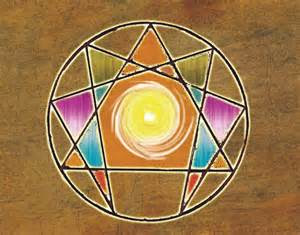
The Enneagram symbol is a nine-pointed, star-like figure. The nine lines comprise a perfect triangle and a twisted hexagon contained within a circle. This is a New Age type mandala, a mystical gateway to personality classification. The drawing is based upon a belief in the mystical properties of the numbers 7 and 3. (source)
Excerpt from an Article by Ed Hird:
Enneagram and the Occult
Gurdjieff’s work led to the formation of the New-Age cult, Arica, founded by his disciple Oscar Ichazo. It was Ichazo and his colleague Claudio Naranjo (an instructor at the Esalen Institute) who together developed the Enneagram in the 1960s as an indicator of personality in its current form.(14) Naranjo merged the Enneagram with 9 of Freud’s 10 personality defense mechanisms….
Barbara Metz, SND, and John Burchill, OP, recommend the Enneagram as a way of engaging in “kything prayer”. Kything Prayer can be done with any other person, present or absent, dead or alive, whose Enneagramic reading ‘moves against your numerical arrows’. The key is to “let your center find itself within the person with whom you are kything” and to “Picture yourself within the [other] person.” An alternative form of Enneagramic kything is to “invite the other person’s spirit into themselves.”(19) One may very well ask how appropriate it is for Christians to be inviting the spirits of the dead into themselves. Does this not slide into occultic channeling/mediumistic practices that are clearly forbidden by Holy Scripture?(20) Is it enough for Enneagram advocates like Jim Scully of Pecos Abbey to say “that ‘occult’ and ‘satanic’ are not synonyms? God told me back in 1979 that the greatest issue facing the Church in the 1990’s would be the deception of inter-faith syncretism. Maybe it is time for us as Anglicans and Christians to truly wake up and repent of our syncretistic mixing of Christ and the occult, of good and evil, of truth and deception, of light and darkness. “Gurdjieff and the Enigmatic Enneagram” by Ed Hird, Anglican Renewal Ministries of Canada

An article from The Berean Call

Are You My Type? The Enneagram Catches on with Christians
The Enneagram came to the United States in the 1970s, where it initially caught on among Catholic seminarians and priests and became a tool for spiritual formation.
In its present form, the Enneagram includes nine personality types, or numbers, illustrated by a nine-pointed geometric figure. (The term Enneagram comes from the Greek words meaning “nine” and “drawing” or “figure.”) Each, at its worst, is tied to one of the deadly sins – plus two more traits that have been added in.
A person’s “type” is determined by self-examination; the goal being to better understand oneself – and one’s strengths, weaknesses and tendencies – and those of others.
But it may not be as modern as it sounds, or as alien to the faith as some might fear. In fact, some trace the Enneagram to a fourth-century Christian monk and ascetic named Evagrius, whose teaching later influenced the formation of the seven deadly sins, according to Cron and Stabile. Others detect elements of the Enneagram within Sufism and Judaism. (source)
_______________________________________________________________
Marianne Williamson: If I Am President, I Will Take Control of Your Children and Make Them New Agers
By Philip Gray
Course in Miracles promoter, Marianne Williamson, who is running in the 2020 presidential election, has big plans for the children of this country if she is elected. Among other things, part of those plans is to make sure children in American public schools are trained in mindfulness meditation. While tens of thousands of public schools in the U.S. are already teaching children mindfulness meditation, no doubt, with a New Age president, every school would be including it.
As president, I would advocate for the following: Mindfulness training in the schools.—Marianne Williamson, 2019 (source)
Williamson also promises to advocate for “universal pre-K.” This would help make sure that children as young as 3 and 4 would be placed into the public school system. Advocates of universal pre-K believe they need more time with America’s children and want to get their hands on them much earlier than 5 or 6 (Kindergarten).
Parents beware. If Marianne Williamson (or another candidate with her “values,”) becomes president, this country’s children will be at even greater risk than they are now. And you can be sure, she will not be advocating for homeschooling families.
(photo from bigstockphoto.com; used with permission for editorial purposes)
_______________________________________________________________
The Significance of Understanding Leonard Sweet’s 
“More Magnificent Way of Seeing Christ”
LTRP Note: Over the past few decades, a number of New Age sympathizers have had a significant influence in the evangelical church. One of the chief is Methodist author, speaker, and teacher Leonard Sweet. Sweet openly calls the Father of the New Age Movement—the late Jesuit priest Teilhard de Chardin—“twentieth-century Christianity’s major voice.” Sweet also teaches the foundational New Age doctrine that God is “in” everyone and everything—that God is embedded in all creation. Brought forward and popularized by Rick Warren, Leonard Sweet and his New Age sympathies have not been adequately addressed by today’s pastors and church leaders. A look on Sweet’s website shows he has partnered with numerous popular figures such as Brian McLaren, Mark Batterson (Circle Maker), Erwin McManus, Mark Driscoll, Frank Viola, and Karen Swallow Prior (professor at Liberty University). The following booklet by Warren Smith reveals the “New Age Christianity” that Leonard Sweet has helped to bring into the church.
By Warren B. Smith
To survive in postmodern culture, one has to learn to speak out of both sides of the mouth.1—Leonard Sweet

Who is Leonard Sweet?

Leonard Sweet is an ordained Methodist minister who is presently the E. Stanley Jones Professor of Evangelism at Drew University in Madison, New Jersey. He is also a visiting distinguished professor at George Fox University in Portland, Oregon. On his various websites, he is described as a “scholar of American culture” who has authored over 60 books and 200 articles and has published over 1500 sermons. A “Phi Beta Kappa graduate,” he is a “frequent speaker at national and international conferences, state conventions, pastor’s schools, retreats” and “serves as a consultant to many of America’s denominational leaders and agencies.” Descriptive terms such as “distinguished,” “most influential,” “widely quoted,” “highly sought after,” and “the Picasso of Preaching” give visitors to his website the distinct impression that this is a man they should definitely pay attention to. And many people are doing just that.
Day-to-day believers may or may not be familiar with Leonard Sweet, but many in Christian leadership are very familiar with this self-described “semiotician.” According to his website, a semiotician is someone who “sees things the rest of us do not see and dreams possibilities that are beyond most of our imagining.” And as a “cultural futurist” and “Christ follower,” he seems to be very comfortable assuming the role of a postmodern prophet who provides hip observations of what is and what will be. His mission is to help the church become more culturally relevant in the 21st century. However, as he attempts to walk the narrow line between the Gospel and the world, he frequently walks over that line into the false teachings of the New Age/New Spirituality. When he does, legitimate questions need to be raised about what he is doing.
In June 2010, Sweet became the object of a swirling controversy, and his name suddenly disappeared from the list of scheduled speakers at a National Worship Conference taking place in Albuquerque, New Mexico. The controversy centered around the New Age implications of many of the quotes and teachings found in his 1991 book Quantum Spirituality: A Post Modern Apologetic. Prior to the conference, a number of people were starting to ask pertinent questions about Sweet and what he was teaching. In my 2009 book A “Wonderful” Deception, I wrote three chapters on Leonard Sweet and the obvious New Age implications of what he was teaching. In the first chapter on Sweet, I described some of my initial impressions regarding this man, and in particular, his book Quantum Spirituality:
Highly intellectual and well-read, Leonard Sweet almost dares you to keep up with him as he charges through the spiritual marketplace. Operating at lightning speed and quoting from countless books and articles, he will impress many readers with his quick wit and spiritual insights. However, as he treacherously dives into New Age waters and challenges his readers to go there with him, serious problems arise within his “postmodern apologetic.”
In reading Quantum Spirituality, I recalled the Sermon on the Mount when Jesus warned that you can’t serve two masters (Matthew 6:24). Leonard Sweet may be a professing evangelical Christian, but he also simultaneously praises New Age authors and their teachings.2

Sweet’s “Response” to Critics

Keenly aware of the controversy he has created, Sweet has a statement prominently posted on his present home website titled—“A Response to Recent Misunderstandings.” While his attempt to explain himself might satisfy the uninformed reader, his “Response” does not address the specifics of what he has written and is actually teaching. His simplistic denunciation of the New Age is unconvincing. His statement that the “New Age rhymes with sewage” and his encouraging the use of a “daily ritual of starting the day by standing in front of a mirror and saying: “God is God and I am not” do not speak to the fact that he has never even addressed, much less renounced, the specific New Age teachings that he was otherwise appearing to deny and disparage. And his stating “back when the New Age was a movement” completely misses the fact that the New Age movement never went away. Those of us who came out of New Age teachings and have been observing the New Age over the past several decades know that contrary to Sweet’s claims, the New Age movement has actually grown exponentially and is now mainstream and an inherent part of our culture. Due to its continued wide-spread growth and influence, the New Age threat to the church (and the world) is larger than ever before. But now it is just hiding in plain sight behind the facade of other names like “New Spirituality,” “New Worldview,” or in Sweet’s case—the “New Light” teachings of a “Quantum Spirituality.” But by any other name a rose is still a rose and the New Age is still the New Age.
Because Sweet’s “A Response to Recent Misunderstandings” left so many unanswered questions and because of his continued influence in the church, it seems imperative that thoughtful Christians take a deeper look at what Leonard Sweet is really teaching. For starters, here are five immediate concerns to consider.

FIVE IMMEDIATE CONCERNS

1) Leonard Sweet teaches the New Age doctrine of “Immanence” that would have the church believe God is “in” everyone and everything

In her 1948 book The Reappearance of the Christ, New Age matriarch Alice Bailey and her spirit guide Djwhal Khul describe how the path to their New Age God will be based on an “immanent” God that is “within every form of life”:
. . . a fresh orientation to divinity and to the acceptance of the fact of God Transcendent and of God Immanent within every form of life. These are the foundational truths upon which the world religion of the future will rest.3 (emphasis added)
Likewise, in his 1980 book, The Reappearance of the Christ and the Masters of Wisdom, New Age channeler Benjamin Creme, states that the New World Religion will be based on the proposition that “Christ” is “immanent”—“in man and all creation”:
But eventually a new world religion will be inaugurated which will be a fusion and synthesis of the approach of the East and the approach of the West. The Christ will bring together, not simply Christianity and Buddhism, but the concept of God transcendent—outside of His creation—and also the concept of God immanent in all creation—in man and all creation.4 (emphasis added)
In Leonard Sweet’s 1999 book SoulTsunami—with its front cover endorsement by Rick Warren—Sweet introduces this same New Age idea of God not only being transcendent but also immanent. He writes:
To survive in postmodern culture, one has to learn to speak out of both sides of the mouth. It should not be hard, since Christianity has always insisted on having things both ways. Isn’t it based on the impossible possibility of Jesus being “beyond us, yet ourselves” (poet Wallace Stevens)? Biblical theological is not circular with a fixed center, but elliptical, revolving around the double foci of God’s immanence and God’s transcendence.5 (emphasis added)
Sweet clearly spells out what he means by “immanence” in his 1991 book Quantum Spirituality: A Postmodern Apologetic. As a self-described “radical,” he presents his “radical doctrine” that God is immanently embodied “in” His creation. He writes:
Quantum spirituality bonds us to all creation as well as to other members of the human family. . . . This entails a radical doctrine of embodiment of God in the very substance of creation. . . . But a spirituality that is not in some way entheistic (whether pan- or trans-), that does not extend to the spirit-matter of the cosmos, is not Christian.6 (emphasis added)
But Sweet’s “radical” panentheistic doctrine is a key New Age teaching—as is so much of what he wrote in Quantum Spirituality. In his “A Response to Recent Misunderstandings,” Sweet tries to dispel questions about Quantum Spirituality by saying, “Would I write the same book today? No. Would I say the same things differently? Yes. I started working on the book in my late 20s. I hope I’m older and wiser now.” But when it comes to the New Age implications of what he is teaching, he is not any wiser in regard to his previously stated New Age doctrine. In several subsequent books, Sweet reintroduces his New Age doctrine of immanence—that God is immanently embodied “in” His creation. For example, in his 1999 book Soul Tsunami, Sweet writes:
Postmodern evangelism is first of all telling people how special they are, how much God loves them, how unique each and every one of them is. The fourth-century theologian Athanasius said in one of his letters that God became one of us “that he might deify us in Himself.” Similarly, elsewhere he wrote that Christ “was made man that we might be made God.”7
In Sweet’s 2010 book Nudge: Awakening Each Other to the God Who’s Already There, he expresses in different words what he wrote in Quantum Spirituality about the “embodiment of God in the very substance of creation”:
An incarnational God means that God-stuff is found in the matter of the universe.8
In this same book he also wrote, “Nudgers help people discover their inner Jesus.”9 But God is not “in” everyone and everything. Jesus is not “in” everyone and everything. Sweet may seem to denounce the New Age, but what he is teaching is New Age. This is dangerous and unbiblical leaven. The apostle Paul lamented that it only took “a little leaven” to lure the Galatians away from the Gospel they once knew so well.
Ye did run well; who did hinder you that ye should not obey the truth?  This persuasion cometh not of him that calleth you. A little leaven leaveneth the whole lump. (Galatians 5:7-9)
God states in the first commandment, “Thou shalt have no other gods before me.” The New Age “God” who is “in” everyone and everything is another “God” and therefore a false God. Contrary to Leonard Sweet’s teaching in Quantum Spirituality, God is not embodied in His creation. Contrary to his teaching in Nudge, “God-stuff” is not found in the matter of the universe, and everyone does not have an “inner Jesus.” Scripture is very clear. Man is not God because God is not “in” everyone and everything. In Jeremiah 16:20, God warned: “Shall a man make gods unto himself, and they are no gods?” In Matthew 23:12, Jesus warned, “And whosoever shall exalt himself shall be abased; and he that shall humble himself shall be exalted.” For further scriptural references on why God is not “in” everyone and everything and how this false teaching has entered both the world and the church, see my booklet Be Still and Know that You Are Not God.

2) Leonard Sweet describes the “Father” of the New Age Movement” as “Twentieth-century Christianity’s major voice”

Sweet describes heretical Jesuit Catholic priest Pierre Teilhard de Chardin—the “Father of the New Age Movement—as “Twentieth-century Christianity’s major voice.” 10 In her best-selling New Age classic, The Aquarian Conspiracy, author Marilyn Ferguson describes Teilhard de Chardin as “the individual most often named as a profound influence by the Aquarian Conspirators who responded to a survey.”11 He is also the most frequently referenced New Age leader in her book. The Teilhard quote “This soul can only be a conspiracy of individuals” is found on the very first page of her book and inspired her to title her book The Aquarian Conspiracy. Ferguson wrote that “Teilhard prophesied the phenomenon central to this book: a conspiracy of men and women whose new perspective would trigger a critical contagion of change.”12
Evident in his posted “Response,” Sweet appears to be baffled by everyone’s concern about some of the things he is writing. He seems to take any criticism as a personal attack. But this criticism, if you will, is not about him personally, it is about what he is teaching. Jesus didn’t say “Get behind me Satan” to Peter because he thought Peter was Satan. He said “Get behind me Satan” because of what Peter was saying. And because Sweet describes the “Father of the New Age movement” as “Twentieth-century Christianity’s major voice,” I believe the Lord would tell Leonard Sweet the same thing today. This should become especially evident when you read the following unbiblical statements made by Teilhard de Chardin in his book Christianity and Evolution:
What I am proposing to do is to narrow that gap between pantheism and Christianity by bringing out what one might call the Christian soul of pantheism or the pantheistic aspect of Christianity.13 (emphasis added)
The cross still stands . . . But this is on one condition, and one only, that it expand itself to the dimensions of a New Age, and cease to present itself to us as primarily (or even exclusively) the sign of a victory over sin.14
I can be saved only by becoming one with the universe.15
I believe that the Messiah whom we await, whom we all without any doubt await, is the universal Christ; that is to say, the Christ of evolution.16
[I]f a Christ is to be completely acceptable as an object of worship, he must be presented as the saviour of the idea and reality of evolution.17
A general convergence of religions upon a universal Christ who fundamentally satisfies them all: that seems to me the only possible conversion of the world, and the only form in which a religion of the future can be conceived.18

Teilhard Again?

Sweet’s affection for Teilhard de Chardin surfaced again in his 1999 book Aqua Church. After quoting a strong Bible-based stanza from the hymn “Jesus Savior Pilot Me,” Sweet follows it with a very revealing quote from Teilhard de Chardin. Teilhard stated that those who “see” Christ as he does understand Christ in “a much more magnificent way” than all those who went before him:
Christ is in the Church in the same way as the sun is before our eyes. We see the same sun as our fathers saw, and yet we understand it in a much more magnificent way.19
Really? Teilhard and his followers understand Christ in a much more magnificent way than their “fathers”? More than all the martyrs? More than the original disciples? This seems to indicate that Teilhard and Sweet and their “semiotic” emergent postmodern “Christ followers” are “seeing” something about Christ that the rest of the church does not see. Would Sweet have the church believe that Chardin’s seemingly updated New Age “Christ” is the real Christ? Is the “semiotic” Sweet trying to show us that if we adopt the New Age teachings of Teilhard, we, too, will “see” Christ in a “much more magnificent way” than the Christians who came before us? Sadly, it would seem that this is so.
Sweet seems to believe that with new understandings from quantum physics, a New Age/New Gospel/New Spirituality/Quantum Spirituality would enable Christians to see Christ in a much deeper and “more magnificent way.” The church would finally understand that the science of quantum physics proves that God is an energy force that interpenetrates and embodies His creation. Therefore, we are all “connected” because we are all “God” because God is “in” everyone and everything. Sweet argues that Christians of the past weren’t ready to deal with things like quantum physics, quantum wavelengths, and the New Age implications of a Quantum Spirituality that would totally transform their faith and challenge everything they thought they knew about being a Christian. In his 2016 book Jesus Speaks, Leonard Sweet writes:
The Holy Spirit brings Jesus’ voice to life through history, theology, science, and social experience. Jesus told the disciples, “I have much more to say to you” (John 16:12). In other words, Jesus was saying, “You can’t handle everything I have to say to you right now. Some of my truth has a wavelength, and it needs time, maybe even centuries, to play itself out.20
But this implies that God’s Word is incomplete and insufficient and therefore in need of new revelation. This is simply not true. Besides, when Jesus said “I have much more to say to you, He was talking to His disciples—not to the church today. It is also important to notice how Sweet conveniently squeezed “wavelength” into his interpretation of Jesus’ words to set up his Quantum Spirituality. But Jesus wasn’t withholding spiritual insights that would have to be delivered to His people two thousand years later. This kind of false teaching is an inherent part of the New Age deception. The fact is Jesus has already given us everything we need to know in His Holy Bible.
Jesus warned of false prophets who would come in sheep’s clothing (Matthew 7:15). And there would be those who honor Him with their lips, but their hearts would be far from Him (Matthew 15:8). He also warned of those who serve two masters (Matthew 6:24). Psalm 144:11 warns of vain men who deceive with the “right hand of falsehood.” In Psalm 12:2, David warned of those who speak with a “double heart.” In James 1:8, James taught that “a double minded man is unstable in all his ways. In 1 Timothy 3:8, Paul referred to these same men as “double-tongued.” For Leonard Sweet to exalt the “Father of the New age movement”—Teilhard de Chardin—and suggest that Teilhard’s way of seeing Christ is a “much more magnificent way” than our forefathers is to fall prey to our Adversary’s deceptive devices. One thing is for sure: The New Age movement hasn’t gone away—it has entered the church through men like Teilhard de Chardin and those like Sweet who exalt him as “Twentieth-century Christianity’s major voice.”

(3) Leonard Sweet Praises New Age leaders as his “Heroes” and “Role Models”

While some Leonard Sweet defenders argue that his postmodern “New Light” apologetic flies right over the heads of “Old Light” “fundamentalist” types, the facts tell a different story. But what one learns in reading Quantum Spirituality is that Sweet wants to transform biblical Christianity into a Quantum Spirituality that is, in reality, a New Age/New Spirituality. Without any apology, Sweet writes that he is part of a “New Light” movement, and he describes those he especially admires as “New Light leaders.” But many of Sweet’s “New Light leaders” are New Age leaders who are in the process of overturning biblical Christianity through obliging New Age sympathizers like Leonard Sweet.

Sweet’s New Age “role models and heroes”

In the acknowledgments section of Quantum Spirituality, Leonard Sweet expresses his deep gratitude and admiration to various “New Light leaders” whom he openly praises as “the most creative religious leaders in America today.” But many of these “New Light leaders” are New Age leaders. Included in this group are a number of men I was very familiar with from my years in the New Age—among them are Willis Harman, Matthew Fox, and M. Scott Peck. Sweet describes these three men—along with numerous other New Age figures cited—as “extraordinary” and “great” New Light leaders. He goes so far as to say that they are his “personal role models” and “heroes” of “the true nature of the postmodern apologetic.” Sweet writes:
They are my personal role models (in an earlier day one could get away with “heroes”) of the true nature of the postmodern apologetic. More than anyone else, they have been my teachers on how to translate, without compromising content, the gospel into the indigenous context of the postmodern vernacular.21
But many of the men and women Leonard Sweet cited have compromised the “content” of the Gospel by translating it into the “postmodern vernacular” of a New Age/New Spirituality. For example, Willis Harman, Matthew Fox, and M. Scott Peck have all played leading roles in the initial establishment and popularization of today’s New Age/New Spirituality movement. But rather than commending these New Age/New Light leaders, a self-professing Christian leader like Sweet should be warning the church about them. A brief look at these three “New Light” leaders and their teachings will make this very clear.

Willis Harman (1918-1997)

Willis Harman is listed as one of the most influential Aquarian/New Age conspirators in Marilyn Ferguson’s The Aquarian Conspiracy. Harman was a social scientist/futurist with the Stanford Research Institute and one of the chief architects of New Age thinking. He wrote the book Global Mind Change:The New Age Revolution in the Way We Think. A review by The San Francisco Chronicle on the front cover of the book reads: “There never has been a more lucid interpretation of New Age consciousness and what it promises for the future than the works of Willis Harman.”22

Matthew Fox (1940- )

Another one of Sweet’s self-described “role models” and “heroes” is Matthew Fox, a former Catholic priest who was dismissed from the Catholic church for openly professing heretical New Age teachings—teachings that include those of his revered mentor, Pierre Teilhard de Chardin. Fox, like Teilhard, teaches that all of creation is the “Cosmic Christ”—therefore the Cosmic Christ is “in” everyone and everything. In his book The Coming of the Cosmic Christ, Fox writes: “Divinity is found in all creatures.”23 and “We are all royal persons, creative, godly, divine, persons of beauty and of grace. We are all Cosmic Christs, ‘other Christs.’ But what good is this if we don’t know it.”24 Leonard Sweet actually credits Fox in a footnote in Quantum Spirituality for inspiring Sweet’s own description of the “cosmic body of Christ” and actually refers readers of Quantum Spirituality to Fox’s New Age book The Coming of the Cosmic Christ.25

M. Scott Peck (1936-2005)

M. Scott Peck, the late psychiatrist and best-selling author of The Road Less Traveled, is another one of the “role models” and “heroes” that Leonard Sweet cites in his book Quantum Spirituality. The Road Less Traveled was on the New York Times best-seller list for over ten years. In a subsection of his book titled “The Evolution of Consciousness,” Peck describes God as being “intimately associated with us—so intimately that He is part of us.”26 He also writes:
If you want to know the closest place to look for grace, it is within yourself. If you desire wisdom greater than your own, you can find it inside you . . . .To put it plainly, our unconscious is God. God within us. We were part of God all the time.27
When Matthew Fox’s The Coming of the Cosmic Christ was published in 1988, the lead endorsement on the back of Fox’s book was written by M. Scott Peck. Peck and Fox were obviously in New Age agreement. Peck, like Fox and Sweet, describes Pierre Teilhard de Chardin in glowing terms. He describes Teilhard as “[p]erhaps the greatest prophet” of the “mystical,”  evolutionary leap that will take mankind toward “global consciousness” and “world community.”28 And it is this mystical New Age Christ of Pierre Teilhard de Chardin, Willis Harman, Matthew Fox, M. Scott Peck, and Leonard Sweet that challenges biblical Christianity today.

4) Leonard Sweet thanks New Age Leader David Spangler for helping him develop his Quantum Spirituality’s “new cell understanding of new light leadership”

If we want to possess a magic crystal for our New Age work, we need look no further than our own bodies and the cells that make them up.29—David Spangler, 1991
I am grateful to David Spangler for his help in formulating this “new cell” understanding of New Light leadership.30—Leonard Sweet, 1991
In his “A Response to Recent Misunderstandings,” Leonard Sweet states: “Because I quote someone does not mean I agree with everything that person ever wrote.” He goes on to say that “Some of the quotes I chose were meant to provide contrasting positions to my argument, some to buttress my argument, some even to mock my argument. The key consideration to whether I quoted someone was not ‘Do I agree with them?’ but ‘Does this quote energize the conversation?’ ‘Guilt by association’ is intellectually disreputable and injurious to the whole body of Christ.” But there is a big difference between “guilt byassociation” and “guilt by promotion.” Leonard Sweet is praising, thanking, and glorifying many of these New Age leaders—hardly guilt by association, especially when Sweet writes:
I believe these are among the most creative religious leaders in America today. These are the ones carving out new channels for new ideas to flow. In a way this book was written to guide myself through their channels and chart their progress. The book’s best ideas come from them.31
Ironically, one of the “channels” guiding him was an actual New Age channeler—David Spangler. A pioneering spokesperson for the New Age, Spangler has written numerous books over the years. His book The Revelation: The Birth of the New Age is a compilation of channeled transmissions that he received from his disembodied spirit-guide “John.” At one point in the book, Spangler documents what “John” prophesied about “the energies of the cosmic Christ” and “Oneness”:
As the energies of the Cosmic Christ become increasingly manifest within the etheric life of Earth, many individuals will begin to respond with the realization that the Christ dwells within them. They will feel his presence moving within and through them and will begin to awaken to their heritage of Christhood and Oneness with God, the Beloved.32
In a postmodern-day consultation that bears more than a casual resemblance to King Saul’s consult with the witch of Endor (1 Samuel 28), Leonard Sweet acknowledges in Quantum Spirituality that he was privately corresponding with New Age channeler David Spangler. Sweet even thanks Spangler for assisting him in forming his “new cell understanding” of “New Light leadership.”33 But as believers we are to “have no fellowship with the unfruitful works of darkness.” Rather than thanking them, we are to reprove and expose them (Ephesians 5:11).

(5) Misapplication of Quantum Physics: Trying to Draw Spiritual Truth From Physical Theory

Leonard Sweet—just like New Age leaders—tries to use Quantum Physics to prove that God indwells his creation.
The coming together of the new biology and the new physics is providing the basic metaphors for this new global civilization that esteems and encourages whole-brain experiences, full-life expectations, personalized expressions, and a globalized consciousness.34—Leonard Sweet, SoulTsunami
When we experience such a quantum of transformation, we may simultaneously feel that the whole of the New Age is happening right now, that we are on the verge of overnight transformation—the fabled quantum leap into a new state of being.35—David Spangler, Reimagination of the World
We have the epitome of a great science . . . quantum physics . . . Everyone is God.36—New Age Channeler J.Z. Knight, What the Bleep Do We Know
In his book The Tao of Physics: An Explanation of the Parallels Between Modern Physics and Eastern Mysticism, New Age physicist Fritjof Capra describes the union of mysticism and the new physics. He wrote “this kind of new spirituality is now being developed by many groups and movements, both within and outside the churches.”37 As an example of how this “new spirituality” is moving into the church, he actually cites one of Leonard Sweet’s “role models” and “heroes”—Matthew Fox.38
When Sweet refers to the new biology and the new physics as metaphors, he stretches these “metaphors” to the position of being actual fact. From his understanding of quantum physics, he asserts that all things are composed of energy and that this quantum energy must be God, hence God is embodied in all things. Yet, this metaphor falls on its face when we learn from Paul’s writings that God and creation are two separate things as is illustrated in chapter one of Romans: “Who changed the truth of God into a lie, and worshipped and served the creature more than the Creator” (Romans 1:25). Paul further exposes the error of spiritualizing physical creation showing that all things are not God, nor are they even spiritual. As he points out, the “earthy” is only temporary and will be done away with:
So also is the resurrection of the dead. It is sown in corruption; it is raised in incorruption . . . There is a natural body, and there is a spiritual body. . . .  As is the earthy, such are they also that are earthy: and as is the heavenly, such are they also that are heavenly. . . . Now this I say, brethren, that flesh and blood cannot inherit the kingdom of God; neither doth corruption inherit incorruption. (1 Corinthians 15:42, 44, 48, 50)

Leonard Sweet and Rick Warren’s “New Spirituality”

In their 1995 joint presentation The Tides of Change, Leonard Sweet and Rick Warren had a quantum conversation as they discussed “waves,” “quantum metaphors,” “revival,” and what they were calling—even back then—a “New Spirituality.” Sweet told Warren:
Yeah, this is a wave period. I really love that metaphor of the wave and the wavelength. First of all, it is a quantum metaphor. It brings us out of the Newtonian world into this new science.39
Quantum waves, quantum wavelengths, quantum metaphors—all leading to a universal Quantum “God” and the Quantum New Age “Christ” of a New Spirituality, a New Worldview, and ultimately a New World Religion—a New World Religion that will be based on New Age teachings that have been labeled scientific but are, in reality, “science falsely so called”:
Laying up in store for themselves a good foundation against the time to come, that they may lay hold on eternal life. O Timothy, keep that which is committed to thy trust, avoiding profane and vain babblings, and oppositions of science falsely so called: Which some professing have erred concerning the faith. Grace be with thee. Amen. (1 Timothy 6:19-21)

Conclusion

Teilhard de Chardin, Leonard Sweet, and an ever-growing band of New Age sympathizers would have us believe that all those who preceded us in the faith were unable to “see” the big picture, because, after all, they didn’t have access to all the new scientific discoveries that we have today—scientific information that would have helped them gain the new spiritual understandings that Leonard Sweet claims to have acquired.
In that vein, Leonard Sweet, Rick Warren, and other Christian leaders are now teaching that God is in the process of bringing a new “Reformation”40 and a “great spiritual awakening” to the church. Sweet writes: “God is birthing the greatest spiritual awakening in the history of the church.”41 Yet this new reformation and great awakening Sweet heralds, is falsely founded on his hybridized New Age Christianity with its “radical doctrine of embodiment of God in the very substance of creation.”42 Ironically, while Sweet—as previously mentioned—encourages “a daily ritual” of standing in front of a mirror affirming “God is God and I am not,” he at the same time tells people that, as a part of creation, God is embodied in them. He also encourages people to be “nudgers.” He says “nudgers are not smudgers of the divine in people.”43 “Nudgers help people discover their “inner Jesus.”44
When the true Christ was asked what will be the sign of his coming and the end of the world, He said, “Take heed that no man deceive you.”(Matthew 24:4)—that many false prophets would arise and deceive many (Matthew 24:11). He specifically warned us to beware of false prophets who come in sheep’s clothing. He said we would know them by their fruits.
Beware of false prophets, which come to you in sheep’s clothing, but inwardly they are ravening wolves. Ye shall know them by their fruits. Do men gather grapes of thorns, or figs of thistles? (Matthew 7:15-16)
We must exhort one another daily. We must continue to preach the Word and not fall prey to those who would diminish the Word with their worldly wisdom, clever stories, metaphors, and false teachings. The Bible and our Lord Jesus Christ always have been and always will be sufficient for all our needs.
Preach the word; be instant in season, out of season; reprove, rebuke, exhort with all longsuffering and doctrine. For the time will come when they will not endure sound doctrine; but after their own lusts shall they heap to themselves teachers, having itching ears; And they shall turn away their ears from the truth, and shall be turned unto fables. (2 Timothy 4:2-4)
Regarding Leonard Sweet’s “radical doctrine of embodiment of God in the very substance of creation,” Jesus warns:
Ye hypocrites, well did Esaias prophesy of you, saying, This people draweth nigh unto me with their mouth, and honoureth me with their lips; but their heart is far from me. But in vain they do worship me, teaching for doctrines the commandments of men.45 (Matthew 15: 7-9)
To order copies of Leonard Sweet—A More Magnificent Way of Seeing Christ?, click here. 
Endnotes
1. Leonard Sweet, SoulTsunami: Sink or Swim in New Millennium Culture (Grand Rapids, Michigan: Zondervan Publishing House, 1999), p. 28.
2. Warren B. Smith, A “Wonderful” Deception: The Further New Age Implications of the Emerging Purpose Driven Movement (Magalia, CA: Mountain Stream Press, 2009), p. 106.
3. Alice A, Bailey, The Reappearance of the Christ (New York, NY: Lucis Publishing Company, Lucis Press, Ltd., 1948), 1996, p. 150.
4. Benjamin Creme, The Reappearance of the Christ and the Masters of Wisdom (London, England; The Tara Press, 1980), p. 88.
5. Leonard Sweet, SoulTsunami, op. cit., p. 28.
6. Leonard Sweet, Quantum Spirituality: A Postmodern Apologetic (Dayton, OH: Whaleprints for SpiritVenture Ministries, Inc., 1991, 1994), p. 125.
7. Leonard Sweet, SoulTsunami, op. cit., p. 304.
8. Leonard Sweet, Nudge:Awakening Each Other to the God Who Is Already There (Colorado Springs, CO: David C. Cook, 2010), p. 157.
9. Ibid., p. 40.
10. Leonard Sweet, Quantum Spirituality, op. cit., p. 106.
11. Marilyn Ferguson, The Aquarian Conspiracy: Personal and Social Transformation in the 1980s (Los Angeles, CA: J.P. Tarcher, Inc., 1980), p. 50.
12. Ibid., p. 25.
13. Pierre Teilhard de Chardin, Christianity and Evolution (New York, NY: Harcourt Brace Jovanivich, Inc., 1971), p. 56.
14. Ibid,. pp. 219-220.
15. Ibid,. p. 128.
16. Ibid,. p. 95.
17. Ibid,. p. 78.
18. Ibid,. p. 130.
19. Leonard Sweet, Aqua Church: Essential Leadership Arts for Piloting Your Church in Today’s Fluid Culture (Loveland, CO: Group Publishing, Inc., 1999), p. 39.
20. Leonard Sweet and Frank Viola, Jesus Speaks: Learning to Recognize & Respond to the Lord’s Voice (Nashville, TN: W Publishing Group, an imprint of Thomas Nelson, 2016), p. 85.
21. Leonard Sweet, Quantum Spirituality, op. cit., p. viii.
22. Willis Harman, Global Mind Change: The New Age Revolution in the Way We Think (New York, NY: Warner Books, 1988), front cover.
23. Matthew Fox, The Coming of the Cosmic Christ: The Healing of Mother Earth and the Birth of a Global Renaissance (San Francisco, CA: Harper & Row Publishers, 1988), p. 154.
24. Ibid., p. 137.
25. Leonard Sweet, Quantum Spirituality, op cit., pp. 124, 324.
26. M. Scott Peck, The Road Less Traveled: A New Psychology of Love, Traditional Values and Spiritual Growth (New York, NY: Simon & Schuster, 1978), p. 281.
27. Ibid.
28. M. Scott Peck, The Different Drum: Community Making and Peace (New York, NY: Simon & Schuster, 1988), pp. 205-206.
29. David Spangler and William Irwin Thompson, Reimagination of the World: A Critique of the New Age, Science, and Popular Culture (Santa Fe, NM: Bear & Company Publishing, 1991), p. 62.
30. Leonard Sweet, Quantum Spirituality, op. cit., p. 312.
31. Ibid., p. ix.
32. David Spangler, The Revelation: Birth of A New Age (Elgin, IL: Lorian Press, 1976), p. 177.
33. Leonard Sweet, Quantum Spirituality, op. cit., p. 312.
34. Leonard Sweet, SoulTsunami, op. cit., p. 121.
35. David Spangler and William Irwin Thompson, Reimagination of the World, op. cit., p. 126.
36. What the Bleep Do We Know (DVD) (20th Century Fox, 2004, http://www.whatthebleep.com), transcribed by author.
37. Fritjof Capra, The Tao of Physics: An Explanation of the Parallels Between Modern Physics and Eastern Mysticism (Boston, MA: Shambhala Publications, Inc., 1999), p. 341.
38. Ibid.
39. The Tides of Change (A 1995 audio presentation with Leonard Sweet and Rick Warren that was part of an ongoing series called “Choice Voices for Christian Leadership,” distributed by Abington Press). On file with publisher.
40. Leonard Sweet, SoulTsunami, op. cit., p. 17.
41. Ibid., p. 34.
42. Leonard Sweet, Quantum Spirituality, op. cit., p. 125.
43. Leonard Sweet, Nudge, op. cit., p. 31.
44. Ibid., p. 40.
45. Leonard Sweet, Quantum Spirituality, op. cit., p 125.

To order copies of Leonard Sweet—A More Magnificent Way of Seeing Christ?, click here. 
Related Reading:
Be Still and Know That You are Not God!—God is Not “in” Everyone and Everything