
"SHACK" THEOLOGY: WHERE IS THE DEVIL?
BY WARREN B. SMITH
republished below in full unedited for informational, educational, and research purposes:
I wonder you should ask me whether it is essential to keep the patient in ignorance of your own existence. That question, at least for the present phase of the struggle, has been answered for us by the High Command. Our policy, for the moment, is to conceal ourselves.1 – C.S. Lewis, The Screwtape LettersThe Shack’s author, William P. Young, quotes C.S. Lewis favorably and frequently in his books, but The Screwtape Letters by Lewis is not one of the books from which he has quoted. I bring up Lewis, not as an endorsement, but to point out a discrepancy. The Screwtape Letters is a novel that presents some of the many ways Christians can be effectively seduced and deceived by Satan and his demons—a subject that is completely ignored in The Shack and in Young’s other books. The discrepancy is that Young chooses quotes from authors like Lewis to serve his own personal and theological agenda while conveniently ignoring writings by the same author that actually contradict his agenda. The Screwtape Letters is a perfect example.
The Screwtape Letters consist of a series of letters sent by a senior seducing spirit named Screwtape to his young understudy Wormwood. In the letters, Screwtape teaches Wormwood how to subtly undermine and eventually destroy the faith of his Christian “patient.” In the quote cited above, Screwtape tells Wormwood to conceal himself in such a way that the designated individual remains unaware of his spiritual presence. And this is exactly what we find in The Shack. The Devil and his deceptive spirits are never mentioned—not even once. It’s no wonder Young avoids The Screwtape Letters when he quotes C.S. Lewis. Acknowledgement of a real Devil and seducing spirits plays no part in The Shack and its supposed expression of Christian theology.
Young has a witty but innocuous C.S. Lewis quote at the beginning of The Shack’s main chapter on relationships.2 But where The Screwtape Letters serves to expose and warn about the ways Satan thwarts and undermines a believer’s relationship with God, Young’s novel—and in particular this chapter on relationships—says absolutely nothing in this regard. Given The Shack’s emphasis on the importance of “relationship,” it seems odd that no mention is ever made in Young’s novel about a believer’s uninvited yet inevitable “relationship” with his Spiritual Adversary—Satan the Devil. There is no acknowledgment, no warning, no advice, no anything in The Shack concerning the Devil, his seducing spirits, and their many wiles.
Contrarily, the Bible tells believers to put on the full armor of God, so they can stand fast against the wiles of the Devil and powers of darkness that are very real (Ephesians 6:11-13). We are admonished to be “sober” and “vigilant” because our Spiritual Adversary is walking around like “a roaring lion” and “seeking whom he may devour”—whether that be in a shack or anywhere else (1 Peter 5:8-9). We are told to resist the Devil and his temptations with the Word of God—not with human wisdom and “relationship” (Matthew 4:1-11).
Young’s easy dismissal of the Devil implies that our Spiritual Adversary is not someone we have to contend with in our lives and relationships. Young goes so far as to teach that “evil and darkness” don’t even exist. Young puts these words in the mouth of his “Holy Spirit” character “Sarayu”:
Both evil and darkness can only be understood in relation to Light and Good; they do not have any actual existence.3But this is what the universal New Age Christ teaches—that “evil does not exist.” This false universal Christ states:
Innocence is wisdom because it is unaware of evil, and evil does not exist.4With darkness having no existence of its own, it’s no wonder that Young’s presentation of evil and darkness agrees with the teachings of the New Age rather than the teachings of the Bible. His expressed disbelief in the existence of independent evil goes right along with his self-confessed universalist leanings.5
Hidden in Plain Sight
The Shack’s Papa “God” cites a number of inhibiting factors concerning “relationship” in what Papa calls “all the limiting influences in your life that actively work against your freedom.”6 These limiting influences are also referred to as “that confluence of multifaceted inhibitors.”7 But again, Young fails to make any mention of the Devil as one of these influences or inhibitors. For a man who likes to quote C.S. Lewis, Young might want to read or reread The Screwtape Letters. It would seem that Wormwood-like seducing spirits have effectively convinced Young they have no existence. As a consequence of this spiritual deception, Young has defined the Devil right out of existence—out of The Shack, out of his “Christian” theology, and out of the Bible. Sadly, most Shack readers become so emotionally caught up in Young’s novel, they never notice that the Devil is completely absent from his Shack story and Shack theology.So where is the Devil in Young’s novel? Be sure of this—the Devil’s presence completely overshadows and thoroughly permeates the pages of The Shack. Cloaked in humor, clouded in human wisdom, concealed in flattery, tucked away in mockery and sarcasm, and hidden in half-truths and lies, the Devil thoroughly inhabits the many conversations that ultimately produce Young’s universal, New Age-flavored Shack theology. The Devil may appear to be absent from The Shack, but for those who have the eyes to see, the Devil is the unspoken force that inspires Young and purposely and cunningly drives his novel. As they say, the Devil is in the details. The Devil is not absent from The Shack, he is just hidden in plain sight.
For we have not followed cunningly devised fables, when we made known unto you the power and coming of our Lord Jesus Christ, but were eyewitnesses of his majesty. (2 Peter 1:16)Endnotes
Lest Satan should get an advantage of us: for we are not ignorant of his devices. (2 Corinthians 2:11)
- C. S. Lewis, The Screwtape Letters (New York, NY: Macmillan Company, 1960), p. 39.
- William P. Young, The Shack: Where Tragedy Confronts Eternity ( Los Angeles, CA: Windblown Media, 2007), p. 104.
- Ibid., p. 136.
- A Course in Miracles: Combined Volume (Glen Ellen, CA: Foundation for Inner Peace, 1975) (Text) p. 38.
- Wm. Paul Young, Lies We Believe About God (New York, NY: Atria Books, 2017), pp. 118-119. (Young states that he believes in universal salvation.)
- William P. Young, The Shack, op., cit., p. 95.
- Ibid.
BOOKLET – The Shack and Its New Age Leaven by Warren B. Smith
The Shack’s Universal Papa
“The Shack,” TBN, and the New Age
___________________________________________________
“Truths We Believe about God” Theological Review of “Shack” Author’s New Book: “Lies We Believe About God”
The movie was released in the same time as Young's latest book By Pastor Larry DeBruyn
SEE: http://herescope.blogspot.com/2017/05/truths-we-believe-about-god.html;
republished below in full unedited for informational, educational, and research purposes:
A Biblical & Theological Refutation of Wm. Paul Young’s book, Lies We Believe About God
But
there were false prophets also among the people, even as there shall be
false teachers among you, who privily shall bring in damnable heresies,
even denying the Lord that bought them, and bring upon themselves swift
destruction.
—The Apostle Peter, 2 Peter 2:1, KJV
—The Apostle Peter, 2 Peter 2:1, KJV
Introduction
As promoted by the best-selling religious allegory The Shack, a non-Christian worldview is playing around with the mind and soul of evangelicalism even to questioning of salvation’s meaning. With the release of the movie by the same name, The Shack’s verbal images are now being visualized. Contemporaneously, and capitalizing upon the publicity generated by the movie, yet another book by Wm. Paul Young has hit the market, Lies We Believe About God.[1]
 |
| Note the Yin/Yang, light/dark symbolism |
What Young covertly taught by allegory and metaphor in The Shack he now overtly teaches in Lies—teachings among others, regarding God, humanity, love, and salvation. Reportedly, Young admitted that, “The Shack is theology.” And then added, “But it is a theology wrapped in a story.”[2]
Now in Lies We Believe About God, the shrouded “story” plays a more minor role as Wm. Paul Young openly states his theology. Young continues to exert a compelling presence among mainstream evangelicals through his interviews, books and release of the movie, The Shack. Leaders Pat Robertson and James Robison have praised the movie.[3] Featuring the book’s author, the Trinity Broadcasting Network (TBN) has recently aired a weekly program Restoring The Shack.[4]
Why Be a Christian?
But despite their popularity, Young’s teachings contradict what Scripture teaches about God, humanity, love and salvation (his contention being that all people are reconciled to God, are friends with God; i.e., universalism), and this conflict needs to be addressed. His revisionist thinking about “Christian beliefs” does not derive from seeing the faith through the lens of Holy Scripture, though he might pretend it to be otherwise, but rather through a prism of his life experiences and emotions. His devastating life experiences while growing up in New Guinea as an MK (Missionary Kid) may explain his journey as to why he has come to believe what he believes. But while the negative emotions aroused by his experiences, and similarly those of others, may explain why Young feels the way he does about some of the evangelical culture’s expressions of belief, they do not excuse his departure from biblical Christianity; that is, if biblical Christianity is to remain the true way of understanding and approaching God.
The purpose of this writing is not to deal with all the issues Young raises in Lies We Believe About God. While he raises a few legitimate concerns which I might share, most of them are illegitimate. What I find irreconcilable with the authority of Scripture is the template he forces on the Christian faith and how wedded to his life experiences, he tries to fit the Bible and its teachings into the psychological and philosophical way he views the world.

For example, if, as he states, all people are universally reconciled to God (Young: Are you suggesting that everyone is saved?... That is exactly what I am saying! LWBAG, 118), then why believe Christianity? (John 14:6) Isn’t that Young’s point by using an atheist as an example of being a child of God to disprove the lie, “Not Everyone is a child of God.”? (LWBAG, Chapter 24, 203-208)[5] If early Christians had not believed in the exclusivity of the Gospel, the Christian church’s genius would have been lost and Christianity would have reduced itself to the status of a sect in the first century. If I thought universalism to be true, I would possess no compulsion to believe Christianity or encourage others to place their faith in Jesus Christ for salvation. If in the Trinity I along with every other soul on this planet already have an eternal and loving relationship with God, then no matter what I believe or how I behave I am going to be God’s friend and go to heaven anyway, right? It may take time to work out the friendship between God and me, but we’ll get there.

“Unshackled: Breaking Away from Seductive Spirituality”[6]
Previously to this writing and eight years ago, I expressed my concerns regarding the theology of Paul Young as expressed via story, allegory and metaphor in The Shack. My reservations were written in my book, Unshackled: Breaking Away from Seductive Spirituality (2009). Interested readers can also consult my article about the “god” of The Shack posted years ago on the website Herescope titled, Elousia and the Black Madonna: Imagination, Images and Impurity in “The Shack.”[7] The purpose of this writing is not to replay previous writings contained in Unshackled, but rather to biblically and theologically interact with and refute Paul Young’s teachings in his book, Lies We Believe About God; namely, that by virtue of descent from the Trinity via creation, every human being is through Jesus connected to God in a personal, organic, dynamic and eternal relationship (Genesis 1:26-30; 2:7).[8]
Thus we turn to look at the view of salvation Young promotes in his book (really, all his books) Lies We Believe About God. To begin with, I would like to share the paradigm Paul Young employs to measure Christianity, how he determines what are the truths and what are the lies regarding the faith. Understanding this template will help readers to see, I hope, why Young embraces some beliefs and why he discards others. And I might add, around this worldview much of the popular pan-evangelical movement appears to be coalescing.
The Author’s Spiritual Template
As I have reflected upon two of his books, The Shack and Lies We Believe About God, a spiritual template emerges—call it a paradigm, straight jacket or grid—by which Young measures his spiritual truth derived from the aggregate of his life experiences—as well as those of others (good and bad)—his psychological preferences, his philosophical perspectives, his twisting of Bible passages, his theological musings and his beliefs about God. In order to be included as part of the “relationship” between God and man as his template fashions it, his religious experiences and beliefs must fit in accord with his misgivings about the Christianity he experienced while being part of the North American fundamentalist-evangelical subculture (being an MK, Bible college student, etc.).

The Themes of His Template
The core of his template is this: Young believes that universally all humans have a relationship with God and are redeemed and reconciled to Him. Everything in life—all cultural experiences, Scripture and theology—must, conditioned by his and other’s experiences and accompanied by his explanations, be molded to fit his belief system. If life events, evangelical expressions of faith or Scriptural teachings don’t fit his system of “truth,” they are considered “lies” (few, a very few, deservedly so). Thus the question arises, because he writes from a claimed Christian perspective, what are the psychological, philosophical, biblical and theological underpinnings which form the universalistic template by which he determines his truth that everybody’s saved because they’re in a relationship, either enjoying or not enjoying it, with God? To explain why he believes what he believes, we will try to unpack these assumptions.
 |
| (Movie endorsements for The Shack. Source) |
Three Themes
Indicating where he’s coming from, there appears to be three general themes which form his paradigm: first, by virtue of creation, the universe and the Tri-Personal God (Father, Son and Spirit.) co-exist in oneness; second, in this oneness the Trinity infuses the universe with the Love (spelled with an uppercase “L”) they interpersonally experienced before the foundation of the world (John 17:23, 24, 28); and third, every human by virtue of having been created by and being immanently inside the Trinity has, does and will participate in this divine “Love” Young calls “Relationship.”

First Theme: The Universe and Universalism
To Young God is the Tri-Personal being who infuses and permeates the whole of creation which he spells a couple of times with an upper case “C” (Creation) in Lies We Believe About God and approximately twenty times (Creation) in The Shack. In doing so, he suggests nature is possessed of divineness. Presumably, the universe exists because in a symphony of unity the Trinity created it (Father, Son and Spirit, Genesis 1:1-2 and John 1:1-4). But this created universe, and here’s the catch, exists “inside” the Trinity.
In the Foreword to Young’s book Lies We Believe About God, C. Baxter Kruger, a Trinitarian theologian, explains the relationship of the Three-Person Oneness of God to creation like this: “Inside of this moving divine dance of relationship, everything was created: every human being, every plant, every subatomic particle, everything.” (Emphasis added, LWBAG, 127-128). So in this view creation is not separate from, but is contained in the Tri-Personal God. The universe is inside, not outside the Trinity. The Trinity is the container, the universe becomes the contents, and God infuses Love into the contents so that no separation exists between container and contents.
Remember: Both Young and Kruger tell readers there’s no separation between the Trinity and humanity, no us and them. (LWBAG, 232, 11) Question: How do compatriots Kruger and Young know everything’s inside the Trinity? Do they arrive at this conclusion through philosophical speculation, their Sophia? Is that the basis? (In The Shack wisdom or Sophia is not Christ (1 Corinthians 1:24, 30), but “a personification of Papa’s wisdom,” 171).

Note: Kruger, as presumably Young, views the whole creation as dwelling within the Trinity (i.e., as Young would say, “No separation!”). By implication, it can be postulated that the converse of this creation-relation-equation can also be believed; that the Trinity indwells a dancing creation the Tri-Personal God shares with “every human being, every plant, every subatomic particle, everything.” If it is assumed that creation is symbiotically inside the Trinity and the Trinity inside the creation, then as represented by Jesus the prototypical human—“every single human being is in Christ... and Christ is in them.” (LWBAG, 119)
This quantum-like physics worldview (where like gravity the Trinity’s energy or Force of Love infuses and permeates the entire cosmos) is monism or oneness, i.e., all is one and one is all. This eastern-like mystical and New Age worldview implies that the universe and the Triune God exist together in a harmonious and rhapsodic movement (No separation!) of dance, in a sort of hypostatic union comparable to the way in which the divine and human fused and danced together in the Word incarnate, Jesus Christ. In such a symbiotic relationship (Creator and Creation “need” each other.) the creation feeds from the Trinity and the Trinity feeds from the creation (Yin/Yang or As Above, So Below).

God as the Ground of Being is thus the God in whom Tillich would have us place our trust. But this God belongs to the circle [“We are a circle of relationship,” Papa tells Mack about the Trinity in The Shack, 122] of pantheistic theory. Ultimately, Tillich’s God absorbs everything into Himself [ed., like Young and Kruger’s model of the universe—everything is “inside” the Trinity].[10]
Tillich’s dialectical theology “has been variously designated as a system of Gnosticism, naturalism, pantheism, and atheism; and all these designations are, more or less, accurate.”[11]

In addition to Tillich, Young and Kruger borrow from and are popularizing the theology of Jürgen Moltmann (1926- ), in many ways the “father” of the emerging church, who used “the classical term perichoresis to speak of the mutual relations among the divine persons in God.”[12] This perichoresis relationship (Greek peri = “around” combined with choresis = “choreographed”), also called “social” Trinitarianism, co-inherence, “the dance,” Moltmann extends “to all relations, including mutual interpenetration among beings in the world and their mutual interpenetration with God.”[13]

In cosmic co-inherence, not unlike quantum theory, the Tri-Personal God and all that comprises the universe symbiotically dance together, mutually moving with, among, between and in each other in an ethereally loving and dancing relationship. As the title of Cooper’s book indicates, Young and his friend Kruger are peddling and popularizing panentheism within the greater evangelical, charismatic and emergent church communities—that God is in everything (contrast pantheism, everything is God).

Because
that, when they knew God, they glorified him not as God, neither were
thankful; but became vain in their imaginations, and their foolish heart
was darkened. Professing themselves to be wise, they became fools, And
changed the glory of the uncorruptible God into an image made like to
corruptible man, and to birds, and fourfooted beasts, and creeping
things.
—Romans 1:21-23
—Romans 1:21-23
Kruger’s quotation of Moltmann indicates his connection to the German theologian. To introduce chapter 9—“The Oneness of the Spirit, Son, and Father”—of his book The Shack Revisited, he quotes:
By virtue of their eternal love they live in one another to such an extent, and dwell in one another to such an extent, that they are one.Thus, any understanding that God is Holy (“holy” means to separate, to be set apart, and to be sanctified) becomes quite naturalized.[15] And by the way, if the Lord God is not Holy (Revelation 4:8) then neither is He Worthy (Revelation 4:9-11).
—Jürgen Moltmann[14]

But in a worldview like Young and Baxter’s there is no separation between Creator, creation and creature. As Cooper points out, this worldview is panentheistic (God dwells in all, and all dwells in God), though both Young and Kruger probably would not outright state this to be the case. But it might also be classified, at least according to the stated characteristics of their paradigm, to be pantheism. In stating something that sounds eerily familiar to what Young and Kruger write, Andrews defines monism-pantheism:
The essential element of Pantheism... ‘is the unity of God and nature, of the Infinite and the finite, in one single substance.’ The Infinite is not swallowed up in the finite, nor the finite in the Infinite, but both co-exist; and this co-existence is necessary and eternal [ed., by Young and Kruger’s reckoning, everything eternally exists inside the Trinity]. Thus we have the One and the many, the Absolute, the All. It will have no dualism, it will unify nature, man, and God.[16]
This then is their sense of their universalism, the Trinity circularly moving, “dancing” and changing together in the oneness of Love, and in the process (enter process theology) why not let the whole creation, “every human being, every plant, every subatomic particle, everything” join the great quantum-cosmic dance? Then indeed, there will be “no separation” between God and humans as biblical words sin, wrath, condemnation and judgment imply, only Love manifested in “dancing,” “sharing” and “relationship”—the next word we move on to consider.
 |
| (Perichoresis illustration - Source) |
Second Theme: The Universe and Relationship
God is Love, and because the whole creation exists inside the Trinity, there is as has been stated, no separation between God and humans. The Tri-Personal Deity infinitely and eternally loves; each member equally loving the other two without personal diminishment, jealousy or competition between and among them (To state again, this is called perichoresis, co-inherence, social Trinitarianism or “the dance”). Their “dancing” relationship the Tri-Personal God desires to see reproduced between them and all humanity, and this the sovereign Tri-Personal deity has done, is doing and will continue to do ad infinitum. Because all creation exists “inside” the Trinity, creation becomes infused, like gravity, with the Love they share. “Relationship” therefore becomes actualized between God and every human being who ever lived.

Extending out of the Trinity’s union with creation, God is understood by Young to love humans unconditionally, and humans, though they might not realize it just yet, to similarly love God. (After all, they’re inside the Trinity!) Though some humans do not find themselves necessarily “fond” of God, God always remains fond of them (“Fond” is Young’s synonym for love, “We are especially fond of you,” Papa says to Mack in The Shack, 234). It may take time for some humans to become “fond” of God (i.e., develop a relationship), but sooner or later when they wake up to Love, whether in this life’s dimension or the next, they will (Talk about determinism...!).
Of course, such a scenario flies in the face of the Apostle Paul’s statement that there are those who are “haters of God” (Romans 1:30). Yes, some people can’t have a relationship with God because they hate Him!
Having looked at the aspect of relationship in Young’s worldview, we turn now to the subject of redemption and reconciliation.
 |
| (Source) |
Third Theme: The Universe and Redemption-Reconciliation
Because God has lovingly wedded all humans into oneness—they are inside the Trinity—within him, her or them (Young’s hermaphroditic [androgynous, ed.*] goddess “Papa” in The Shack) they experience union with God, an eastern-mystical-like union which transcends time, matter and space. Young states that, “every single human being is in Christ (John 1:3), and Christ is in them, and Christ is in the Father (John 14:20). When Christ—the Creator in whom [Note: not “by” whom.] the cosmos was created—died, we all died. When Christ rose, we rose (2 Corinthians 5).” (LWBAG, 119) Young then adds that “prior to the foundation of the world, we were all included;... saved in eternity... all included in the birth, life, death, resurrection, and ascension of Jesus (2 Corinthians 5:19).” (LWBAG, 119)
From birth, if not before, Young teaches that the whole of humanity, being inside the Trinity, was somehow metaphysically “present” with Jesus in the great redemptive event of history, his life, death, burial, resurrection and ascension into heaven. All humans therefore have experienced, are experiencing, or will experience reconciliation and relationship with the Tri-Personal God because “all” were eternally in Christ when He redeemed-reconciled them to him/her/them “selves.” Baxter Kruger writes that to speak the name “Jesus” is to speak in “oneness,” the name of the Trinity. He explains,
Therefore, to speak the name of Jesus is to say that the Triune God, the human race, and all creation are not separated, but together in relationship. Jesus is Himself the relationship; He is [ed., by virtue of His incarnation] the union in between the Triune God and the human race. (LWBAG, 11)
Kruger then explains that this is “why Paul and I regard the widespread notion that human beings are separated from God as a fundamental lie, one that denies Jesus’s very identity”—and presumably, denies our identity also, an identity of being from time immemorial metaphysically and transcendently one in Jesus, which oneness has now totally become immanent. (LWBAG, 11)
Note: I do not deny the truth that in positional union in/with Christ all believers have together been made alive, raised up and seated in heaven with Christ (Ephesians 2:5-6; Colossians 2:12; Romans 6:3-7). What I do deny are the universal implications which Young prejudicially extracts from the great truth of believers-only union with/in Christ to extend it to every single human being who ever lived.
 |
| Read more concerns HERE |
The Template’s Summary
This is the spiritual template of Wm. Paul Young and C. Baxter Kruger, a grid through which Scripture must pass and then be molded to fit into their paradigm of universalism. This is the foundation upon which they base their beliefs. (Bible verses had better fit, or else!). In the last part of the book and in an attempt to prove his fantastic scheme of universal relationship-redemption-reconciliation, Young weaves together a series of Scripture passages, something he calls A Catena. He extracts and intertwines thirty-four Scripture passages in his catena, many extracted from the Apostle Paul’s letters. In this weaving-deceiving he attempts to make biblically believable the conversation he’s having with naïve readers. His catena only includes passages containing the words “all,” “every,” “world,” “cosmos,” “everything” or “everyone,” passages he personally selects to fit his template and provide cover for his aberrant theology. About this method of using the Bible we ought to recall words of the Apostle Peter. Young’s approach to Bible quotation or allusion resembles that of “untaught and unstable” teachers who distort the meaning of Scripture to their own and others’ destruction if they swallow “hook, line and sinker” what is being cast to them (2 Peter 3:16).

Young presumes that because all creation is “inside” the Trinity, because the Love of the Trinity resides in union with all creation, and because all humanity before time participated in the life, death, resurrection and ascension of Jesus, all are, have been or will be redeemed-reconciled with God. For readers who might have read or be reading The Shack or Lies We Believe About God, I ask that you consider my assessment of Paul’s paradigm to see whether or not his arguments can best be understood against this backdrop. Universal Love as expressed in universal relationship-redemption-reconciliation is the template Young tries to fit God and humanity into, and no matter what, they are going to fit!
This is the New Age-New Worldview-New Spirituality destination the evangelical movement appears to be traveling towards. Though the movement’s trains, whether the New Apostolic Reformation, the Emerging Church, Neo-Calvinism, the Charismatic Movement (add Liberal Denominations, Catholicism and Primitivism into the mix) etc., seem to be traveling on different tracks, they will arrive at the same hub: pantheistic nature worship. If not Christ, religious persons will devoutly deify and worship the cosmos, and then themselves. “I was an atheist” the T-shirt saying goes, “until I found out I am God.”
About the captivating religious box Young and Kruger have constructed for people to put their trust in, no matter how earthly-wise the packaging of it, the Apostle Paul gave this warning to believers: The box is empty!
Beware lest any man spoil [captivate] you
through philosophy [love of sophistry]
and vain deceit [empty deceptions],
after the tradition of men [human wisdom not God’s],
after the rudiments of the world
[the constituent particles and powers of the universe],
and not after Christ. For in Him [Not us!]
dwelleth all the fulness of the Godhead bodily.
—Emphasis and bracketed comments added, Colossians 2:8-9
through philosophy [love of sophistry]
and vain deceit [empty deceptions],
after the tradition of men [human wisdom not God’s],
after the rudiments of the world
[the constituent particles and powers of the universe],
and not after Christ. For in Him [Not us!]
dwelleth all the fulness of the Godhead bodily.
—Emphasis and bracketed comments added, Colossians 2:8-9
To be continued . . .
Endnotes
[1] Wm. Paul Young, Lies We Believe About God (New York, NY: Atria Books, 2017). Besides this book and The Shack, Young also wrote Crossroads and Eve.
[2] Charity Gibson, “‘The Shack’ Cover Artist Renounces Book for Leading People Astray: ‘I Have Deep Regrets’,” The Christian Post, April 19, 2017 (http://www.christianpost.com/news/the-shack-cover-artist-praised-renouncing-book-i-have-deep-regrets-180895/). Gibson quotes Dave Aldrich who designed the cover for The Shack who quotes Young.
[3] Al Dager, Media Spotlight (Sequim, WA; Omega Ministries Spring 2017): 27.
[4] Trinity Broadcasting Network, March (https://www.tbn.org/programs/restoring-shack).
[5] I will employ the acronym LWBAG (Lies We Believe About God) and page numbers when quoting the book.
[6] Pastor Larry DeBruyn, Unshackled: Breaking Away from Seductive Spirituality (Indianapolis, IN: Moeller Printing Company, 2009). Book available for free PDF download at Discernment Ministries website, http://www.discernment-ministries.org/Unshackled%20by%20L.%20DeBruyn.pdf ; hard copies available from Discernment Ministries, P.O. Box 520, Canton, Texas, 75103; Phone: 903-567-6423.
[7] Pastor Larry DeBruyn, “The Shack, ‘Elousia,’ & the Black Madonna: Imagination, Image, and Idolatry,” Herescope, July 2, 2008 (http://herescope.blogspot.com/search?q=Black+Madonna ).
[8] Pastor Larry DeBruyn, “The Shack and Universal Reconciliation,” Herescope, October 24, 2008 (http://herescope.blogspot.com/search?q=reconciliation ).
[9] Young adapts the phrase “ground of all being” from the term used by Paul Tillich (1886-1965) “to indicate God as the source of all reality or being.” Donald K. McKim, “Ground of Being,” Westminster Dictionary of Theological Terms (Louisville, KY; Westminster John Knox Press, 1996): 122.
[10] Kenneth Hamilton, “Paul Tillich,” Creative Minds in Christian Theology, Philip Edgcumbe Hughes, Editor (Grand Rapids, MI: Wm. B. Eerdmans Publishing Co., 1969): 470.
[11] Vernon C. Grounds, “Pacesetters for the Radical Theologians of the Sixties and Seventies,” Tensions in Contemporary Theology, Stanley N. Gundry and Alan F. Johnson, Editors (Chicago, IL: Moody Press, 1976): 95.
[12] See John W. Cooper, Panentheism The Other God of the Philosophers: From Plato to the Present (Grand Rapids, MI: Baker Academic, 2006): 251. For further study, Kruger recommends the writings of Jürgen Moltmann. See C. Baxter Kruger, The Shack Revisited (New York, NY: FaithWorks, 2012): 267.
[13] Cooper, Panentheism: 252.
[14] Kruger, Shack Revisited, 106. In his chapter’s title note how Kruger subtly employs one definite article “the” to preface Spirit, Son, and Father, contrary to Jesus’ command to make disciples by “baptizing them in the name of the Father and the Son and the Holy Spirit” (Matthew 28:19). The quote subtracts from “the” Trinity in favor of “oneness.”
[15] See Larry DeBruyn, “The Holy God,” Unshackled: 17-22.
[16] Samuel J. Andrews, Christianity and Anti-Christianity in Their Final Conflict, Second Revised Edition (New York, NY: G.P. Putna’s Sons, 1899): 126-127.
*Herescope's editor added this word. Read Warren B. Smith's excellent article "The Shack’s Universal Papa," in which he descibes Papa as not unlike a pagan trickster god. "But in regards to Papa, it states that “in his shapeshifter form he tends to change genders and forms to delight himself." Our friend Warren B. Smith is writing many articles posted at Lighthouse Trails, some which are referenced or linked to in this article, including his most recent: “Shack” Theology: Where Is the Devil?
• TBN Pulls Plug on “Shack” Author’s New Book—Sort of . . .
• “The Shack,” TBN, and the New Age
To read more discernment material about William Paul Young, and his two controversial books THE SHACK and LIES WE BELIEVE ABOUT GOD, including the recent Hollywood movie based on The Shack, see the articles referenced in Pastor Larry’s footnotes above. Also see the many articles posted on the Herescope blog over the years, such as:
• THE SHACK & Its New Age Leaven
• THE SHACK, "Elousia," & the Black Madonna
• THE SHACK and Universal Reconciliation
• "UNSHACKLED"
• Quantum Physics and the New Spirituality
Herescope and the Discernment Research Group have been on a badly needed sabbatical since December 2016. This post begins a multi-part series which will be published on Guarding His Flock Ministries website and also Herescope.
Reprinted with author's permission with minor modifications to the textual layout for blog posting. The glossary of definitions throughout this post were added by Pastor Larry DeBruyn for the Herescope version of his article. For the original article see: http://guardinghisflock.com/2017/05/01/truths-we-believe-about-god/#more-3090

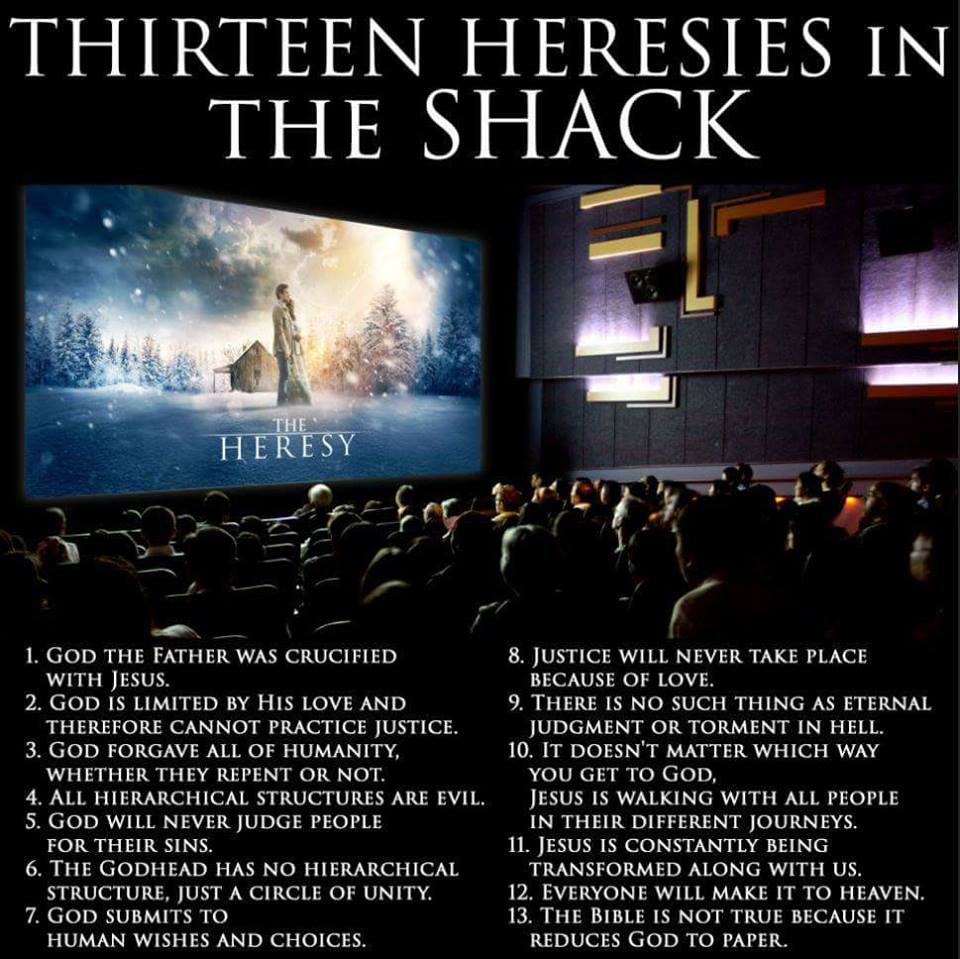
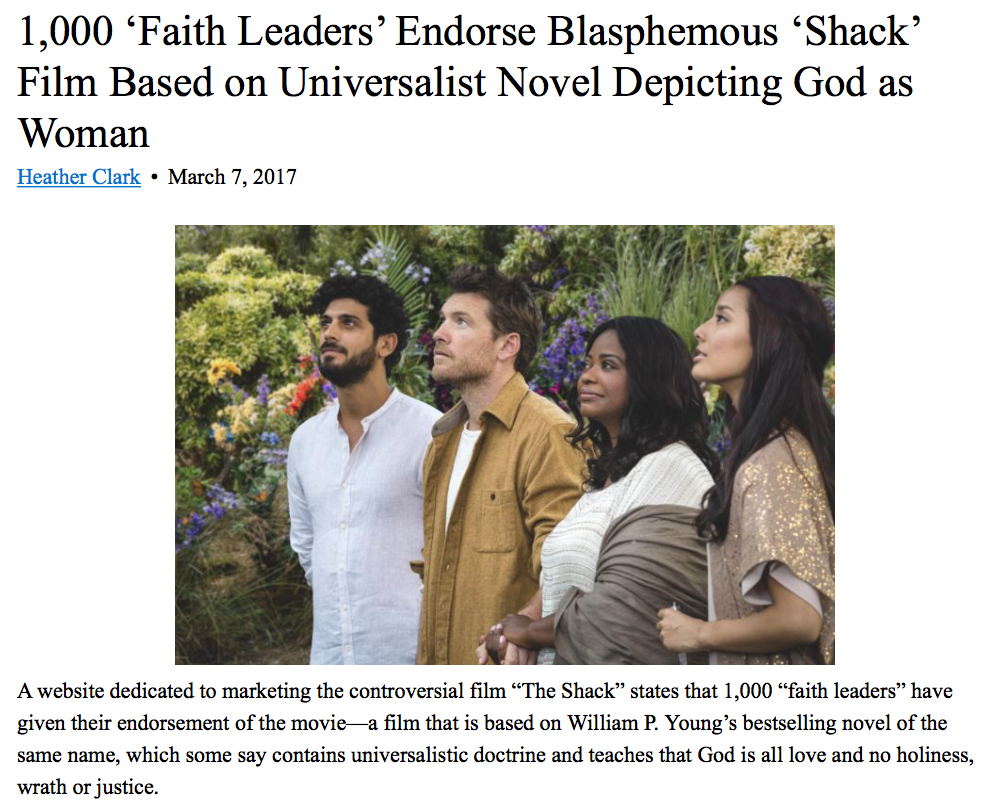
 photo: From L to R: Avraham Aviv Alush as “Jesus,”
Sumire as “Sarayu,” Sam Worthington as “Mack” and Octavia Spencer as
“Papa” in THE SHACK. Photo by Jake Giles Netter.
photo: From L to R: Avraham Aviv Alush as “Jesus,”
Sumire as “Sarayu,” Sam Worthington as “Mack” and Octavia Spencer as
“Papa” in THE SHACK. Photo by Jake Giles Netter.


