Translate

Showing posts with label Money/Currency. Show all posts

Wednesday, July 19, 2017

VISA BRIBES RESTAURANT OWNERS WITH $10,000 TO GO CASHLESS

 https://tribkcpq.files.wordpress.com/2017/07/visa.jpg?quality=85&strip=all&w=770
VISA BRIBES RESTAURANT OWNERS WITH 
$10,000 TO GO CASHLESS 
republished below in full unedited for informational, educational, and research purposes:
07-18-2017 • https://www.technocracy.news
SAN FRANCISCO–(BUSINESS WIRE)–Jul. 12, 2017– Today Visa (NYSE:V) announced it is launching a major effort to encourage businesses to go cashless. Aiming to create a culture where cash is no longer king, the program will give merchants increased ability to accept all forms of global digital payments. Visa will be encouraging and helping merchants go cashless by using innovation to their advantage in order to stay competitively connected to their customers.
To encourage businesses to go cashless, Visa is announcing The Visa Cashless Challenge, with a call to action for small business restaurants, cafés or food truck owners to describe what cashless means for them, their employees and customers. Visa will be awarding up to $500,000 to 50 eligible US-based small business food service owners who commit to joining the 100% cashless quest.
“At Visa, we believe you can be everywhere you want to be, and that it should be easy to pay and be paid in more ways than ever – whether it’s a phone, card, wearable or other device,” said Jack Forestell, head of global merchant solutions, Visa Inc. “With 70% of the world, or more than 5 billion people, connected via mobile device by 20201, we have an incredible opportunity to educate merchants and consumers alike on the effectiveness of going cashless.”
Benefits of Going Cashless
Visa has recognized the net benefits for merchants when they reduce dependency on cash transaction. Visa recently conducted a study that found that if businesses in 100 cities transitioned from cash to digital, their cities stand to experience net benefits of $312 billion per year. According to this study, in New York City alone, businesses could generate an additional $6.8 billion in revenue and save more than 186 million hours in labor, by making greater use of digital payments. This amounts to more than $5 billion annual costs savings for businesses in New York. The complete results with the benefits of going cashless for businesses will be included in the “Cashless Cities: Realizing the Benefits of Digital Payments” report that will be released by Visa later this year.
Reported By Gina Kynast
Editors Note: We know that before the Anti-Christ can rule the world with His mark to demand worship of every person on earth on the pain of death, the world must move to a cashless society.  India and other countries are already moving that direction.  America is now beginning to prepare for that day.  This article is an example of how it will be accomplished.  The banking industry will lead the way.  Please read Rev. Chapter 13 and 14.
Rev 13:11  And I beheld another beast coming up out of the earth; and he had two horns like a lamb, and he spake as a dragon.
Rev 13:12  And he exerciseth all the power of the first beast before him, and causeth the earth and them which dwell therein to worship the first beast, whose deadly wound was healed.
Rev 13:13  And he doeth great wonders, so that he maketh fire come down from heaven on the earth in the sight of men,
Rev 13:14  And deceiveth them that dwell on the earth by the means of those miracles which he had power to do in the sight of the beast; saying to them that dwell on the earth, that they should make an image to the beast, which had the wound by a sword, and did live.
Rev 13:15  And he had power to give life unto the image of the beast, that the image of the beast should both speak, and cause that as many as would not worship the image of the beast should be killed.
Rev 13:16  And he causeth all, both small and great, rich and poor, free and bond, to receive a mark in their right hand, or in their foreheads:
Rev 13:17  And that no man might buy or sell, save he that had the mark, or the name of the beast, or the number of his name.
Rev 13:18  Here is wisdom. Let him that hath understanding count the number of the beast: for it is the number of a man; and his number is Six hundred threescore and six.
_________________________________________________________


Thursday, May 19, 2016

TENNESSEE SUPPORTS GOLD DEPOSITORY, FEARING MONETARY CRISIS

TENNESSEE SUPPORTS GOLD DEPOSITORY, FEARING MONETARY CRISIS 
BY ALEX NEWMAN
republished below in full unedited for informational, educational, and research purposes:

Citing concerns about about a possible economic crisis and a desire for monetary stability, the State of Tennessee is now officially on record supporting the establishment of a depository facility to house gold and other precious metals for Tennesseans. In a remarkable example of bi-partisanship on serious issues, the resolution passed unanimously in both the state House and Senate before being signed by the governor. But more work remains, according to pro-Constitution and sound money activists supporting the efforts.
Analysts and supporters said the measure was an important step on the road to restoring honest money and a stable monetary system based on gold and silver in Tennessee and beyond. As the Federal Reserve banking cartel continues to debase the U.S. dollar and enrich its cronies at the expense of everyday Americans, other states are also exploring and pursuing similar efforts — and in some cases even more ambitious ones, such as a law in Texas establishing a gold-backed bank that lawmakers said would challenge the Federal Reserve's monopoly on currency.
The measure in Tennessee, House Joint Resolution 516, puts the state on record in official support of “the safekeeping and storage of gold and precious metal bullion and coins in a Tennessee bullion depository or other such similar facility.” The resolution also supports the security that such an institution would provide.
According to the measure, the “unpredictable national economy” has led to efforts to achieve “increased monetary stability and liquidity and greater financial security in the event of a national or international financial crisis.” However, despite successful efforts in other states to expand and facilitate commerce in precious metals, the Tennessee resolution does not specifically call for or facilitate the use of precious metals as currency or legal tender.
Still, HJR 516 does acknowledge that concerns about America's economic health have spurred Tennesseans to acquire gold, silver, and other assets that cannot be quietly confiscated via inflation at the whims of central bankers. “In response to the state of our national economy, individuals and entities have purchased gold and other precious metals in the form of bullion and coins in order to achieve the desired financial security and stability,” explains the measure.
Because citizens have been buying up gold and other precious metals, being able to ensure the  “security and safekeeping” of their assets is “paramount to their utilization as investments in the event of an economic crisis,” the final measure declared, implicitly suggesting that the commodities would be used as money in the event of serious turmoil. As such, Tennessee lawmakers decided to support the establishment of an institution in the state to help citizens protect their gold and other precious metals.
HJR 516 was introduced by Tennessee Rep. Bud Hulsey, a Republican and retired lawman from Kingsport, in late January. The bipartisan measure was passed overwhelmingly in March, with 95 votes in favor and none opposed. The next month, it passed unanimously in the Tennessee Senate, with zero “nay” votes and 26 senators in favor of the resolution. On April 27, Gov. Bill Haslam, a Republican, signed it.
Despite its national significance, the media missed the story. However, in a series of articles on its webpage, the non-partisan Tenth Amendment Center, a national group that works to rein in Washington, D.C., and restore the proper constitutional balance between federal and state power, celebrated the measure. After the governor signed it, TAC Communications Director Mike Maharrey said the resolution is “setting the stage for the creation of a state bullion depository, an important first step toward establishing gold and silver as money in the state.”
However, more work remains to be done, he said. “As the next step, a bill to establish a depository should be introduced and passed during the next legislative session,” continued Maharrey, who is also an author of a book on restoring liberty. “There appears to be no barriers to getting this done. Now it’s up to activists in Tennessee to keep the pressure on and ensure the legislators and governor follow through.”
Separately, Maharrey called for state efforts to nullify the Federal Reserve's monopoly on legal tender currency. He also pushed for state adherence to Article I, Section 10 of the U.S. Constitution, which prohibits states from making anything but gold and silver into legal tender. “Creation of a Tennessee Gold Depository would take a step toward that constitutional requirement, ignored for decades in every state,” he continued. “Such a tactic would undermine the monopoly the Federal Reserve System by introducing competition into the monetary system.”
Making gold and silver more easy to use as currency, he added, could bring about important benefits to Tennessee and its people. And there is a bill in Tennessee that would move the state in that direction. However, while HJR 516 passed by massive margins, another piece of legislation that would actually help expand the use of gold and silver in commerce has not yet been approved. Introduced in January by Senator Frank Niceley, Senate Bill 1610 (SB1610) would exempt gold and silver bullion from sales tax. Numerous other states have taken similar action to help expand the use of precious metals in commerce.
It is not the first time lawmakers in the Volunteer State have considered the issue of monetary stability and how Tennessee might prepare for potential crises down the line. In fact, just five years ago, the legislature, joining other states pursuing similar efforts, considered whether the state might adopt an alternative currency in case the Federal Reserve System broke down. In response to questions from attorney Joe Wolverton of The New American, Tennessee State Senator Bill Ketron (R-Murfreesboro), the sponsor of the resolution, offered his thoughts on why it was wise to consider the future.  
“We now owe China in the trillions and Japan is second. What would happen if there was another cataclysmic event? I'm not Chicken Little saying the sky is falling, but prudent businesses are always prepared for the worst-case scenario,” Senator Ketron explained. “The present monetary and banking systems of the United States, centered around the Federal Reserve System, have come under ever-increasing strain during the last several years, and will be exposed to ever-increasing and predictably debilitating strain in the years to come.”
Senator Ketron also pointed out correctly that many widely recognized experts have predicted the “inevitable destruction of the Federal Reserve System’s currency through hyperinflation in the foreseeable future.” And in the event of an economic calamity, if the state is not prepared, its finances and economy could be thrown into chaos, with serious implications for the lives, health, and prosperity of Tennesseans. But by adopting a potential alternative sound currency, the state would be able to avoid, or at least mitigate, many of the problems that would inevitably accompany a breakdown of the Federal Reserve and its increasingly discredited fiat (unbacked) currency.    
Lawmakers in Tennessee are hardly the only ones thinking ahead to the future — and projecting the lines. After all, the out-of-control central bank has now been thoroughly exposed showering trillions on its cronies around the world and bailing out mega-banks with debt-based currency conjured into existence out of thin air. As The New American has documented extensively, numerous states, including Utah, New Hampshire,Oklahoma, Virginia, Arizona, and others, have also adopted or considered measures in recent years related to creating, legalizing, or expanding the use of sound-currency alternatives such as gold and silver.
In Texas, state officials are currently taking bids from companies to build a gold-backed bank and depository institution for the state and its citizens, as well as for anyone who would like to store their precious metals there or use the bank's services. According to Texas Representative Giovanni Capriglione, who authored and sponsored the law that was adopted last year, the bank will allow depositors to bypass the Federal Reserve System and its fiat currency in banking and commerce — all while enjoying the safety and stability that Texas and hard assets can provide.  
In an interview with the popular TruNews radio program, the state lawmaker explained that the bank would be much safer and more reliable than traditional banks, for a number of reasons. “We set up a system of depository agents so you can have any corporation, any group, basically start a depository agent, and they can send and receive through this depository system, outside of the Federal Reserve System,” Capriglione explained. The bank has garnered interest from around the world, he added.   
Of course, Tennessee's latest resolution, state laws making gold and silver legal tender, and even Texas' gold bank are only small steps on the road toward eventually restoring sound currency in the United States. But as the economy continues to deteriorate, notwithstanding the bogus claims of the federal government and the banking cartel styling itself the “Federal Reserve” about an alleged “recovery,” those actions can help point the way for other states looking to restore economic sanity.
The “Fed,” as the central bank is known, has almost destroyed the purchasing power of the U.S. dollar, and the U.S. economy along with it, all to benefit the establishment, the mega-banks, and their cronies. But as states across America are proving right now, that does not have to be the end of the story.
Related articles:

Tuesday, May 3, 2016

NEW DIGITAL CASH SYSTEM WAS JUST UNVEILED AT A SECRET MEETING FOR BANKERS IN NEW YORK

NEW DIGITAL CASH SYSTEM WAS JUST UNVEILED AT A SECRET MEETING 
FOR BANKERS IN NEW YORK
BY MICHAEL SNYDER
SEE: http://www.activistpost.com/2016/05/a-new-digital-cash-system-was-just-unveiled-at-a-secret-meeting-for-bankers-in-new-york.html; republished below in full unedited for informational, educational, and research purposes:

Last month, a “secret meeting” that involved more than 100 executives from some of the biggest financial institutions in the United States was held in New York City.  During this “secret meeting,” a company known as “Chain” unveiled a technology that transforms U.S. dollars into “pure digital assets.”  Reportedly, there were representatives from Nasdaq, Citigroup, Visa, Fidelity, Fiserv and Pfizer in the room, and Chain also claims to be partnering with Capital One, State Street, and First Data.  This “revolutionary” technology is intended to completely change the way that we use money, and it would represent a major step toward a cashless society.  But if this new digital cash system is going to be so good for society, why was it unveiled during a secret meeting for Wall Street bankers?  Is there something more going on here than we are being told?
None of us probably would have ever heard about this secret meeting if it was not for a report inBloomberg.  The following comes from their article entitled “Inside the Secret Meeting Where Wall Street Tested Digital Cash”…
On a recent Monday in April, more than 100 executives from some of the world’s largest financial institutions gathered for a private meeting at the Times Square office of Nasdaq Inc. They weren’t there to just talk about blockchain, the new technology some predict will transform finance, but to build and experiment with the software.
By the end of the day, they had seen something revolutionary: U.S. dollars transformed into pure digital assets, able to be used to execute and settle a trade instantly. That’s the promise of a blockchain, where the cumbersome and error-prone system that takes days to move money across town or around the world is replaced with almost instant certainty.
So it is not just Michael Snyder from The Economic Collapse Blog that is referring to this gathering as a “secret meeting.”  This is actually how it was described by Bloomberg.  And I think that there is a very good reason why this meeting was held in secret, because many in the general public would definitely be alarmed by this giant step toward a cashless society.  Here is more on this new system from Bloomberg…

While cash in a bank account moves electronically all the time today, there’s a distinction between that system and what it means to say money is digital. Electronic payments are really just messages that cash needs to move from one account to another, and this reconciliation is what adds time to the payments process. For customers, moving money between accounts can take days as banks wait for confirmations. Digital dollars, however, are pre-loaded into a system like a blockchain. From there, they can be swapped immediately for an asset.
“Instead of a record or message being moved, it’s the actual asset,” Ludwin said. “The payment and the settlement become the same thing.”
 Why this is so alarming is because we are seeing other major moves toward a cashless system all over the planet.  In Sweden, 95 percent of all retail transactions are already cashless, and ATM machines are being removed by the hundreds.  In Denmark, government officials actually have a stated goal of “eradicating cash” by the year 2030.  And in Norway, the biggest bank in the country has publicly called for the complete elimination of all cash.
Other nations in Europe have already banned cash transactions over a certain amount. Here are just a couple of examples…
As I have written about previously, cash transactions of more than 2,500 euros have already been banned in Spain, and France and Italy have both banned all cash transactions of more than 1,000 euros.
Little by little, cash is being eradicated, and what we have seen so far is just the beginning. 417 billion cashless transactions were conducted in 2014, and the final number for 2015 is projected to be much higher.

The global push toward a cashless society is only going to intensify, because banks and governments both tend to really like the idea of such a system.
Banks really like the concept of a cashless society because it would force everyone to be their customers.  There would be no more hiding cash in a mattress at home or trying to pay all of your bills with paper money.  Under a cashless system, we would all be dependent on the banks, and they would make lots of money whenever we swiped our cards or our “chips” were scanned.
Governments see a lot of advantages in a cashless society as well.  They tell us that they would be able to crack down on drug dealers, tax evaders, terrorists and money launderers, but the truth is that it would enable them to watch, track, monitor and control virtually all of our financial transactions.  Our lives would become open books to the government, and financial privacy would be a thing of the past.
In addition, the potential for tyranny would be absolutely off the charts.
Just imagine a world where the government could serve as the gatekeeper for who is allowed to use the cashless system and who is not.  They could require that we all submit to some sort of government-issued form of identification before being permitted to operate within the system, or it is even conceivable that a loyalty oath would be required.
Of course if you did not submit to their demands, you could not buy, sell, open a bank account or get a job without access to the cashless system.
Hopefully people can understand where this is going.  Paper money is a very important component of our freedom, and if it is taken away from us that will open the door for all sorts of abuse.
Even now, cash is slowly being “criminalized” in America.  For example, if cash is used to pay for a hotel room that is considered by federal authorities to be “suspicious activity” that should be reported to the government.  Of course it isn’t against the law to pay your hotel bill in cash just yet, but according to the government it is something that “terrorists” do so it needs to be closely watched.
It doesn’t take a whole lot of imagination to see where all of this is going.  And for those of us that understand what time it is, this is a clear indication that it is getting late in the game.

Saturday, April 23, 2016

MONETARY POLITICAL CORRECTNESS TO CREATE RACIAL DIVISION: ANDREW JACKSON NOW DEEMED A WHITE RACIST SLAVE MASTER TO BE REMOVED FROM $20 CURRENCY NOTE


Donald Trump Is (Slightly) Wrong About
Harriet Tubman And The 20 Dollar Bill


Americans Petition to Ban Cash and Issue New Digital Dollar for a Cashless Society


Why The Fed Wants To Memory Hole Andrew Jackson
Published on Apr 20, 2016
It has been announced that Andrew Jackson will be replaced on the $20 by Harriet Tubman. Regardless of whose face we use, it’s the Federal Reserve that needs to go. We look at why the faces on our money are there, why Hamilton is not being removed as originally announced and what Andrew Jackson’s Bank War tells us about the Federal Reserve, the Supreme Court and the Constitution in our time. 


$20 Bill is About Creating Racial Division
Published on Apr 21, 2016
Jackson needs to come off because he owned slaves? Jackson saved his country from slavery to the British, from slavery to the Central Bank slavery and from slavery to the dictates of the Supreme Court. Do you realize YOU’RE the slave of the Federal Reserve and Obama? 

BLACK TO THE FRONT; 
WHITE TO THE BACK 
OF THE $20 BILL 
(NOT THE BUS THIS TIME, 
BUT YOU GET IT)

Andrew Jackson, Who Fought Central Bank, Removed From $20 
As “Public Concern For Liberty” Erased
BY MAC SLAVO
SEE: http://www.activistpost.com/2016/04/andrew-jackson-removed-from-20-dollar-bill.html; republished below in full unedited for informational, educational, and research purposes:

The War on Cash has many fronts.
The latest battle is for the face of the currency itself, and the central bankers, who control the front anyway, have imposed a symbolic defeat against the leaders in America’s past who have fought against the stranglehold of the money makers.
Naturally, there are liberal politics at play, fighting for every inch of ground in the war for ideological re-engineering. History is being whitewashed, various figures of antiquity rolling in their graves….
At stake is a dispute for the powers of government even better than the more famous duel between Aaron Burr and Alexander Hamilton, of whom we also speak.
The iconic $20 bill, with the face of President Andrew Jackson, and the $10 bill, with the face of the nation’s first Treasury Secretary, Alexander Hamilton, have long pitted two ideological extremes against each other as they pass along as some of the most used denominations in circulation.
But now, the money powers at the Treasury Department have decided that it is time to add a woman’s face to the money supply as well.
As such, the powers-that-bank have decided to oust Andrew Jackson from the line up, and with it, part of his legacy.
It will be “removed in favor of a female representing the struggle for racial equality,” according to CNN, while an early proposal to remove Alexander Hamilton’s bill will be scrapped, though the proposal includes a redesign on the backs of his and several other notes with scenes from the Woman’s Suffrage Movement, Susan B. and all the gals.
Treasury Secretary Jack Lew is expected to announce this week that Alexander Hamilton’s face will remain on the front of the $10 bill and a woman will replace Andrew Jackson on the face of the $20 bill, a senior government source told CNN on Saturday.
Dramatically, it seems that there was a backlash to counter the coup against Hamilton, including support from former Federal Reserve chairman Ben Bernanke:
The decision to make the historic change at the expense of Hamilton drew angry rebukes from fans of the former Treasury Secretary. The pro-Hamilton movement gained steam after the smash success of the hip-hop Broadway musical about his life this year.
Those pressures led Lew to determine that Hamilton should remain on the front of the bill.
And there’s a reason for Bernanke’s bias towards Hamilton.
It was Hamilton, who from the early days of the nation clamored for a central bank and a strong interventionist federal government.
I have quoted Thomas DiLorenzo on the evil Hamilton before:
Hamilton was a compulsive statist who wanted to bring the corrupt British mercantilist system — the very system the American Revolution was fought to escape from — to America. He fought fiercely for his program of corporate welfare, protectionist tariffs, public debt, pervasive taxation, and a central bank run by politicians and their appointees out of the nation’s capital….
Hamilton complained to George Washington that “we need a government of more energy” and expressed disgust over “an excessive concern for liberty in public men”…
The Philadelphie Federal Reserve publication. A History of Central Banking in America, reports:
Alexander Hamilton, the first Secretary of the Treasury, urged Congress to also assume the war debts of the individual states and then create a national bank to help refinance all these debts. Hamilton’s proposal faced major opposition. Critics said that Hamilton’s bank was unconstitutional, would be a monopoly, and would reduce the power of the states. Although Hamilton won, the bank’s charter was limited to 20 years.
And that’s right where Andrew Jackson’s legacy with the banks picks up.
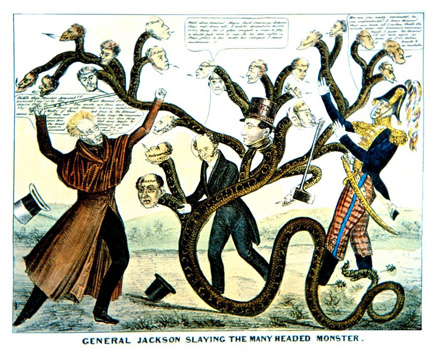
With the charter of the first “Bank of the United States” ending, Jackson was determined to stop the charter of the second “Bank of the United States” and famously stated:
“You are a den of vipers and thieves. I intend to rout you out, and by the eternal God, I will rout you out.” (Andrew Jackson, to a delegation of bankers discussing the recharter of the Second Bank of the United States, 1832)
President Jackson likened their agents to the hydra-beast, with its many heads, and even survived an assassination attempt, by staving off an attacker personally.
jackson-banks-vipersThe bankers, and the powerful families including the Rothschilds who supported it, wanted a “national bank” because they could load the board with “their” guys and outweigh the will of the people and the normal channels of government.

You’ll be kicking yourself for not picking up silver at these prices (Ad)

jackson-route-bankers-national-bankOf course, the same exact state of affairs has been going on today for more than a century with the Federal Reserve, which is run by the successors to the same exact banking interests, including the still immensely-powerful Rothschild family.
The struggle is depicted well in The Money Masters, which spans several centuries of history with the threat of banking powers over individual sovereignty in stark contrast. To be sure, there is an important and nefarious plot afoot to ensnare you, your family and everyone on the block with debt.
There is a line, and you should figure out what side of it you’re going to be on.
Jackson narrowly succeeded in staving off banker domination of the U.S. during his day.
Of course, Andrew Jackson, who was the United States’ seventh president, was also a complete controversy his entire lifetime. It is no surprise that the same people who took down the Confederate flag from the South on the back of a mass shooting tragedy are now trying to tear down the image of a particularly controversial and intriguing figure from the American past.
Jackson was a recalcitrant and unyielding general and war hero, and later an outsider riding a wave of populist support into the White House, bringing in sometimes unscrupulous companions, and plenty of Masons. Many of his backers were diametrically opposed to the entrenched power of New York bankers and speculators, as well as patrician politicians who dominated the first phase of politics in the nation’s history. Jackson played a nasty role in the Trail of Tears affairs with Indians, too, and with the South and Western expansion of slave-friendly territories. Many shades of grey.
Meanwhile, behind the scenes in the founding days of this country, Alexander Hamilton, an advocate of strong central government, and maneuvered on behalf of his banker masters to collectivize the war debt from the states and create a central bank to control the financial strength of the country, and ingrain the early United States with the mindset of the British masters they had just fought to shake off.
After the creation of the Federal Reserve in 1913, and the crisis and consolidation of wealth during the Great Depression, and ever since the 2008 economic collapse, the rule by bankers has become a foregone conclusion, though there will be more chances to shake off their yoke of control. (BitCoin is one possible avenue; Congressionally-controlled greenbacks another; gold and silver yet another…)
Erasing Andrew Jackson from the faces of the fiat funny-money that is passed around by an increasingly ignorant and dependent society (which itself has adopted digital currency as the new norm) will further cut off the past from the masses, and ensure their enslavement.
Read more:
_____________________________________________________________

Tubman’s Replacement of Jackson Highlights Currency Changes

Tubman’s Replacement of Jackson 

Highlights Currency Changes

BY STEVE BYAS
SEE: http://www.thenewamerican.com/economy/item/23019-tubman-s-replacement-of-jackson-highlights-currency-changes; republished below in full unedited for informational, educational, and research purposes:

Harriet Tubman (shown) was an escaped slave who became a major leader in the Underground Railroad — the organized effort to help escaping slaves in the early part of the 19th century. The Underground Railroad used “safe houses” and a network of anti-slavery activists. Tubman died in 1913. After the abolition of slavery, Tubman turned her attention to women’s suffrage. Now, she will become the first person of black African ancestry on American currency, but not the first woman. That honor was held by Pocahontas. The last woman’s whose image appeared on American paper money was Martha Washington.
Tubman replaces Andrew Jackson, who first made it onto a $20 Federal Reserve Note in 1936 (the 100th anniversary of his election as president). Jackson will remain on the back of the note, sharing space with an image of the White House.
Secretary of the Treasury Jacob Lew announced that Tubman will appear on the $20 bill and added that the $10 and $5 bills are also scheduled to have updates, as well. Presently, the Lincoln Memorial is on the back side of the $5 bill. Now, the $5 bill will be redesigned to highlight certain events that took place there, including the famous “I have a dream” speech by Martin Luther King. But Alexander Hamilton, considered the father of American central banking, and Abraham Lincoln, the nation’s 16th president, will continue to grace those denominations of money.
The $10 note had been the next bill scheduled for an overhaul, with the plan to replace Hamilton, but that plan met with a great amount of resistance. Former Federal Reserve Chairman Ben Bernanke contended that Hamilton, as the father of the First Bank of the United States, had a better claim than any other person to be on American currency.
Predictably, any mention of Andrew Jackson includes the obligatory derogatory comments that he was a slave owner and, in the words of the LA Times, his polices “led to the deaths of countless Native Americans.”
Cherokee Chief Bill John Baker weighed in, praising the selection of Tubman, adding that Jackson’s legacy “was never one to be celebrated, and his image on our currency is a constant reminder of his crimes against Natives.”
Certainly, “Old Hickory” is now reviled by the “politically correct” crowd and cast as a man of almost unbelievable evil. The image now perpetuated in the popular American culture, the media, and in academia is more like a comic book villain rather than a real flesh-and-blood human being with many flaws — and many heroic features.
A little perspective is in order.
Andrew Jackson’s role in the Indian removals is certainly part of a dark chapter in American history. He carried out the will of Congress in negotiating resettlement treaties with various tribes. These treaties were overwhelmingly approved by the American public. If we are going to erase the other positive contributions of Jackson to American history because of this, then it is only fair to spread the blame to Congress — and to the people themselves who were alive at the time. And Jackson was not even president for all of the removals. The Cherokee removals actually took place after Jackson was living in retirement at the Hermitage in Tennessee. The Indian removal was an indefensible policy, but Jackson did not even originate the idea of moving the indigenous tribes west of the Mississippi River. After Thomas Jefferson and Congress purchased the Louisiana Territory from the French in 1803, Jefferson urged Native American tribal chiefs to voluntarily move west.
Jefferson was troubled by continued westward expansion, which was leading to the destruction of the Indians’ tribes and culture. As farms moved westward, forest lands, so critical to the tribal economy, were diminished. After Jefferson, others, notably Secretary of War John C. Calhoun, advocated Indian removal. Had public opinion polls been conducted at the time, there is little question that removal would have received strong majority support — whether that removal was effected through voluntary or involuntary means.
Though the Indian removals were certainly a prime example of “democracy in action” (of course, our country was founded as a republic, not a democracy), the back side of the new $5 bill will honor events at the Lincoln Memorial that, in the words of the folks at the Treasury Department, “helped to shape our history and our democracy.”
As Americans pushed up against, and even into, Indian lands, pressure was brought for the government to purchase more and more land from the indigenous tribes. With increasing reluctance, tribes signed away land, extracting promises that the federal government would keep white settlers off the remaining Indian land.
But once again, “democracy” won out. Jackson, a military man, saw firsthand the difficulty in enforcing these promises. Before he removed the Indians, he removed whites — from Indian lands. Then they would return. Any president who actually cracked down on settlers violating tribal sovereignty would face the settlers’ wrath at the polls. These poor settlers may not have had much wealth, but they did have the vote. And they were not afraid to use it.
By the time Jackson took the White House in 1828, it was clear that either Jackson would remove the Indians in the east, or the people would elect a different president who would accomplish the removal of the Indians.
Jackson’s removal of the Indians is certainly a blot on his reputation. But if we are going to delete every person off the currency who has flaws, Federal Reserve Notes would have no portraits.
And Jackson never said, “The only good Indian is a dead Indian.” In fact, Jackson and his wife, Rachel, adopted a little Creek Indian orphan boy.
To say that Jackson is not alone in having done some things wrong is not an argument for keeping him on the $20 bill. So, what did he ever do to deserve his place on American currency in the first place?
Jackson certainly has significant achievements. On January 8, 1815, leading a rag-tag army composed of frontier militia, pirates, and allied Indians, Jackson annihilated the British army at the Battle of New Orleans — an army that had just bested Napoleon. Had he lost, the city might very well not be part of the United States today. Historical illiterates often comment that the battle was actually fought after the War of 1812 was over. Their contention is that the Treaty of Ghent, ending the war, was signed in Belgium several days earlier. Such an assertion does not consider that the treaty was as yet unratified by Parliament, and therefore not yet in effect. Had the British won at New Orleans, it is doubtful the Parliament would have ratified the Treaty of Ghent, and then simply handed the city back to the United States.
Before Jackson became the seventh president, the Republican Party launched by Thomas Jefferson had drifted into adopting many of the policies of the rival Federalist Party, led by Hamilton. While Jefferson had begun his Republican Party largely to oppose Hamilton’s Bank of the United States, regarded by Jefferson as unconstitutional, it was his own party that later chartered a Second Bank of the United States in 1816.
This was a major complaint of the “Old Republicans,” who wanted to restore the party to its constitutionalist roots. The movement needed a popular man who could attract enough voter support to regain control of the government.
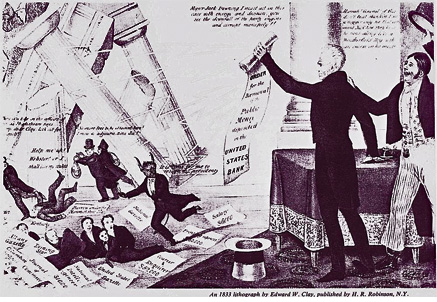
That man was Andrew Jackson. In 1832, in an effort to stop Jackson from winning reelection, Nicholas Biddle, the president of the Second Bank of the United States, brought up its 20-year charter for a renewal vote four years early. The opposition Whig Party thought if Jackson dared to veto the measure, he would lose the election to Henry Clay. If he signed it, their central bank was safe for another 20 years.
Jackson vetoed the bill, leading to the eventual demise of America’s second central bank. In his veto message, he argued that the bank was an unconstitutional granting of a monopoly by Congress (much as Jefferson had argued against Hamilton’s bank many years earlier). He believed it was an example of the wealthy and powerful elites using the power of the federal government to achieve an unfair advantage — much like the “crony capitalism” of today — and was a dangerous concentration of power in the hands of that elite.
The Federal Reserve System, created in 1913, was, in effect, America’s third central bank. Some have wondered if the decision to put Jackson on a Federal Reserve Note — paper money of the sort that was despised by Jackson — was some little joke against the man who had once snuffed out the life of central banking in the United States.
Certainly, Andrew Jackson did both good and bad as president. But Jackson’s victory over the British in 1815, and his killing of central banking in 1832 are certainly both great achievements. While there are other Americans who, it could be argued, have made even greater positive contributions to the country than Jackson (as well as the others who are presently the faces of our currency), there would certainly not be very many.
Jackson would have, no doubt, approved of his removal from a note issued by a central bank in exchange for the abolition of the central bank itself, known in America as the Federal Reserve System.
And as long we are talking about changes to the currency, perhaps we should note that the biggest and most devastating change to the currency has already occurred — making it fiat currency (money not back by a precious commodity such as gold) that can be created out of thin air at a whim, causing inflation.
That was the very thing that Jackson tried to prevent with his great veto, killing central banking in 1832. Hopefully, we will have another president again who will have Jackson's courage to kill the Federal Reserve Bank — and with it, restore the soundness to American currency, making it once again as good as gold.