Common Core Is Rotten to the Core
SEE: http://www.thenewamerican.com/culture/education/item/18437-common-core-is-rotten-to-the-core; WRITTEN BY BRIAN FARMER; republished below in full unedited for informational, educational, and research purposes:
In 1983, the National Commission on Excellence in Education published A Nation at Risk, which warned that the country’s economic, political, and cultural future was threatened by our weak education system. That report stated these now famous lines: “Our nation is at risk.... The educational foundations of our society are presently being eroded by a rising tide of mediocrity that threatens our very future as a Nation and a people.... If an unfriendly foreign power had attempted to impose on America the mediocre educational performance that exists today, we might well have viewed it as an act of war.... We have, in effect, been committing an act of unthinking, unilateral educational disarmament.”A Nation at Risk brought about a renewed focus on what Americans should know and be able to do once they had finished their formal education.
Fast forward to 2001. In that year, President George W. Bush pushed his education policy, which came to be known as “No Child Left Behind,” and which promised to increase student achievement by encouraging states to set high standards and to develop assessments based on those standards. Unlike the initiatives before it, No Child Left Behind required states to test all students in certain subjects and at particular grade levels in order to receive federal funding. Most education experts eventually concluded that No Child Left Behind had failed to deliver real and lasting success, and ultimately left the nation’s schools in a bureaucratic mess.
In 2007, two special interest lobbying groups — the National Governors Association (which helps state governments get federal grants) and the Council of Chief State School Officers (which claims to provide leadership, advocacy, and technical assistance on major educational issues) — started work on a common set of curriculum standards in English language arts and mathematics. By allowing those two groups to lead the effort, it gave the impression that the states initiated the action. In reality, the situation resembled something closer to a Potemkin village. In other words, it was just a façade. Funding for the project was provided by the Bill & Melinda Gates Foundation. To date, the Gates Foundation has provided roughly $250 million to those and other pro-Common Core organizations. One might be inclined to think, “So, what?” But what if that quarter of a billion dollars in funding had come from the Koch brothers? Would people (especially the liberally inclined education establishment) still be likely to think, “So, what?”
It’s worth keeping in mind what inside informant “Deep Throat” told Washington Post reporter Bob Woodward during the Watergate scandal investigation: “Follow the money!”
In December of 2008, the National Governors Association and the Council of Chief State School Officers produced a document on national education standards that would guide the Obama administration during its transition into office. Two months later, the secretary of education announced a federal education grant program known as “Race to the Top.” This program included billions of dollars from the 2009 Stimulus Bill, which was to be used by states to improve academic standards and assessments. In order to receive Race to the Top grants, states had to commit to “a set of content standards that define what students must know and be able to do and that are substantially identical across all states in a consortium.” In 2011, the Obama administration made the adoption of common standards even easier. Most states were still obligated to meet the onerous No Child Left Behind requirements, but the U.S. Department of Education promised No Child Left Behind waivers to states that adopted a common set of college-ready and career-ready standards and assessments. While the U.S. Department of Education did not require states to adopt the Common Core standards specifically, those standards are the only standards that meet the U.S. Department of Education’s criteria. As a result, all but a handful of states ultimately signed on to the Common Core program.
Common Core will now not only provide the framework for what students learn in math and English language arts, but it will also establish two federally funded and approved tests that will replace what states currently use to measure students’ academic success. Not wanting to be left out of the new national education marketplace, private companies are quickly trying to align themselves with the Common Core standards. (After all, there is a great deal of money to be made in this new educational environment!) In order to survive in the Common Core era, textbook publishers and other educationally related industries must show how their materials meet the new national standards. The SAT (Scholastic Assessment Test) and ACT (American College Testing) college entrance exams are also now aligned to Common Core. Those who think that they can avoid Common Core by sending their children to private schools or by homeschooling their children must now deal with a new reality. In addition to college entrance exams, the Iowa Test of Basic Skills and the Stanford 10 — two popular tests used by private schools and by parents who homeschool — will also be aligned to Common Core. Within a few short years, Common Core has gone from being virtually unknown to being a national educational juggernaut that may end up influencing the formal education of tens of millions of elementary, middle-school, and high-school students in America for many years to come, despite the fact that Common Core has some serious flaws.
Cost
Common Core will be very expensive to implement and maintain. The Thomas B. Fordham Institute, a Washington, D.C.-based nonprofit, in 2012 published the study entitled “Putting a Price Tag on the Common Core: How Much Will Smart Implementation Cost?” on the cost of implementing Common Core standards and assessments nationwide, which estimated a price tag of about $16 billion over seven years. But no one really knows what the final price tag for Common Core will be. Most states acted irresponsibly when they adopted the standards because they did not first have a clear understanding of its price tag (they also acted irresponsibly because they did not have a clear understanding of the standards themselves). Many states saw the Race to the Top funds as a way to pay for immediate education expenses and failed to see that they were signing on to something that would be far more expensive in the long run. It should have been obvious that the new education standards and assessments would bring a need for new and different textbooks, tests, teacher training programs, computer software programs, and everything else that goes along with the change and expansion of a federal government program. But politicians and bureaucrats too often do what is expedient, rather than what is in the best interests of the taxpayers.
Privacy
The 2009 Stimulus Bill required states to begin tracking students in a database, starting in their preschool years, until their entry into the workforce. This database will link students’ results on Common Core-related assessments to other personal information, and will be available to a wide variety of departments within the federal government. While supporters of Common Core claim that the system employs measures to protect the anonymity of students, critics have pointed to studies that demonstrate how these measures will not be as secure as supporters assume. But the larger issue remains whether collecting such private information is consistent with the role of the federal government expressed by our nation’s Founders. After all, the data to be collected includes personal information, such as healthcare history, religion, and parents’ income. Defenders of Common Core insist that the data will be used only for the noblest of reasons and will never be part of a federal database. Some Common Core advocates even ridicule those who warn of the potential for abuse that such a system invites. But we should not be too quick to dismiss such possibilities, particularly given the federal government’s questionable track record, and the attitude of “political correctness” that is so rampant in various sectors of our society. Already a student named Brandon Jenkins was denied entry into a college radiation therapy program because of his Christian faith, the IRS has been caught targeting conservative organizations in its audits, and a federal law-enforcement “fusion center” disseminated materials that claimed that veterans and pro-life advocates were likely terrorists.
Quality
Rather than pushing all states toward high standards, Common Core is encouraging a race to the mediocre middle. For example, while Mississippi’s standards appear to get stronger by adopting Common Core, the standards in Massachusetts get weaker. Several curriculum experts have examined the math and English language arts standards and have discovered some alarming weaknesses. In fact, because of those concerns, both Sandra Stotsky and James Milgram, who served on the Common Core’s validation committee, refused to sign the final validation report.
Three philosophical ideas appear to be an integral part of Common Core: statism, moral relativism, and progressivism. First, the statist goals of Common Core are implicit in the lockstep uniformity that is the central thesis of the program. There is a clear intention to mold people through schooling, to overthrow accepted custom and traditional values, and to weaken parental influence. An example of the latter is the development of a curriculum that is so foreign to the parent that the parent cannot help the child with homework assignments. Here is a sample Common Core third-grade math problem found by Townhall: “Add 26 + 17 by breaking apart numbers to make a ten. Use a number that adds with the 6 in 26 to make a 10. Since 6 + 4 = 10, use 4. Think: 17 = 4 + 13. Add 26 + 4 = 30. Add 30 + 13 = 43. So 26 + 17 = 43.” Get it?
Second, relativism’s influence is particularly evident in the “National Sexuality Education Standards: Core Content and Skills, K-12,” which deviates from the Judeo-Christian view of human sexuality. This is not surprising, given that the Advisory Committee included directors from the Planned Parenthood Federation of America and the Gay, Lesbian and Straight Education Network. The relativist philosophical bias reflects what John Dunphy stated in the January-February 1983 issue of The Humanist magazine: “The battle for mankind’s future must be waged and won in the public school classroom. The classroom must and will become an arena of conflict between the old and the new — the rotting corpse of Christianity and the new faith of humanism.” As if that were not alarming enough, Dr. Chester Pearce, professor of education and psychiatry at Harvard University, has expressed the situation even more bluntly: “Every child in America entering school at the age of five is mentally ill because he comes to school with certain allegiances to our Founding Fathers, toward our elected officials, toward his parents, toward a belief in a supernatural being.”
Third, progressive educator John Dewey, often referred to as the “Father of American Education,” argued more than a hundred years ago for a standardized curriculum in order to prevent one student from becoming superior to another, and envisioned a workforce filled with people of “politically and socially correct attitudes” who would respond to orders without question. The traditional, American values of rugged individualism, self- reliance, and personal responsibility are to be rejected and children are to be educated to accept a collectivist world view. As Dewey proclaimed, “You cannot make socialists out of individualists. Children who know how to think for themselves spoil the harmony of the collective society.”
Constitutionality
The biggest concern regarding the implementation of Common Core is the federal government’s ever-increasing role in education. The 10th Amendment of the U.S. Constitution declares, “The powers not delegated to the United States by the Constitution, nor prohibited by it to the states, are reserved to the states respectively, or to the people.” Hence, the power to oversee education belongs to the states or to the people themselves, not to the federal government. This long-standing principle of local control of education is reiterated throughout our laws and government codes. If one accepts Lord Acton’s observation that “power tends to corrupt, and absolute power corrupts absolutely,” then why on Earth would anyone want to give more power to a centralized, bureaucratic, almost unaccountable federal government to control education (or almost anything else, for that matter!)?
Supporters of Common Core like to portray critics as far-right extremists who are paranoid about a government takeover of education. But Diane Ravitch, a respected historian of American education, is no right-wing radical. In February of 2013, Ravitch wrote a commentary, “Why I Oppose Common Core Standards,” in which she summarized many of the concerns that most critics have:
I have long advocated for voluntary national standards, believing that it would be helpful to states and districts to have general guidelines about what students should know and be able to do as they progress through school.
Such standards, I believe, should be voluntary, not imposed by the federal government....
For the past two years, I have steadfastly insisted that I was neither for nor against the Common Core standards. I was agnostic. I wanted to see how they worked in practice....
I have come to the conclusion that the Common Core standards effort is fundamentally flawed by the process with which they have been foisted upon the nation....
President Obama and Secretary Duncan often say that the Common Core standards were developed by the states and voluntarily adopted by them. This is not true.
They were developed by an organization called Achieve and the National Governors Association, both of which were generously funded by the Gates Foundation. There was minimal public engagement in the development of the Common Core. Their creation was neither grassroots nor did it emanate from the states.
In fact, it was well understood by states that they would not be eligible for Race to the Top funding ($4.35 billion) unless they adopted the Common Core standards. Federal law prohibits the U.S. Department of Education from prescribing any curriculum, but in this case the Department figured out a clever way to evade the letter of the law. Forty-six states and the District of Columbia signed on, not because the Common Core standards were better than their own, but because they wanted a share of the federal cash.
Most supporters of Common Core try to hide behind words such as “state-led” and “voluntary.” But anyone willing to take an honest look at what transpired between 2009 and 2011 would conclude that many of those cash-strapped states, already under the burden of budget shortfalls and expensive No Child Left Behind requirements, were seduced by a high-pressure, time-sensitive sales pitch for adopting the standards that included relief in the form of money and waivers.
The idea of common, nationwide standards may sound appealing, but standards alone do not lead to success. One needs to look at the process that is supposed to lead to the attainment of those standards. Educational success depends on the dedication of teachers, the motivation of students, and the support of parents. How does Common Core address those components of the process? One is hard pressed to find the answer to that question when listening to the promoters of Common Core. In fact, one is likely to come away with the impression that Common Core simply does not deal with those issues.
The concerns over Common Core, especially its implementation, are real and troubling. Any of these concerns — cost, mediocrity, and federal overreach — are serious enough that states should consider repealing their adoption of Common Core. Indeed, as the scholastic weaknesses and the skyrocketing implementation costs of the Common Core standards become more evident, many states are scrambling to delay or defund implementation. But a much more fundamental concern exists about Common Core that goes to the heart of any educational experience.
The phrases “college-ready” and “career-ready” appear throughout the Common Core standards. If any other goal is mentioned, such as literacy, it is clearly made out to be of lesser importance. Common Core’s mission statement reflects this notion, as well: “The Common Core State Standards provide a consistent, clear understanding of what students are expected to learn, so teachers and parents know what they need to do to help them. The standards are designed to be robust and relevant to the real world, reflecting the knowledge and skills that our young people need for success in college and careers. With American students fully prepared for the future, our communities will be best positioned to compete successfully in the global economy.”
With such a mission, it is easy to see why so many business leaders support Common Core. Indeed, Common Core receives support from such places as the Chambers of Commerce — the same Chambers that received millions in Gates Foundation money and that want Common Core precisely because it will provide worker drones rather than well-educated individuals. But should career preparation for a “global economy” really be the ultimate educational goal in America?
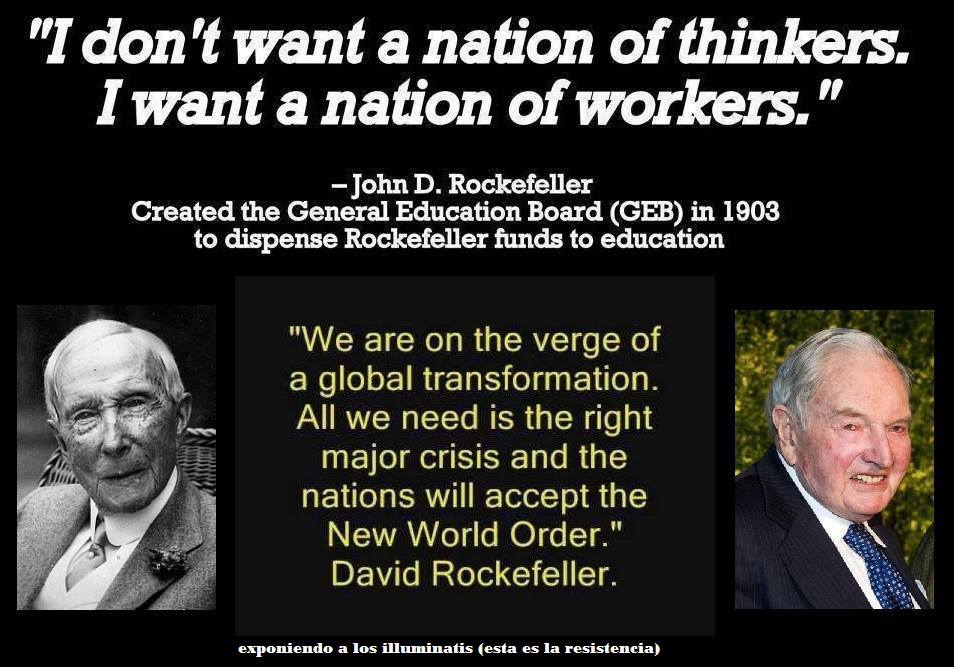
In the ancient world, job preparation was known as “servile education,” because it prepared the student to “serve” a master in a particular type of work. Modern academics would say that it is ridiculous to associate the ancient notion of “servile education” with “skills for the 21st century,” which allegedly would allow students to adapt to an ever-changing society. But as long as students are told that the end of education is a job or career, they will always end up being servants of some master. As oil tycoon John D. Rockefeller put it, “I don’t want a nation of thinkers. I want a nation of workers.”
Joy Pullmann, an education policy analyst with the Heartland Institute, recently addressed Common Core’s misguided focus at a hearing in Wisconsin on Common Core Standards:
In a self-governing nation we need citizens who can govern themselves. The ability to support oneself with meaningful work is an important part, but only a part, of self-government. When a nation expands workforce training, so that it crowds out the other things that rightly belong in education, we end up turning out neither good workers nor good citizens.
The ancients knew that in order for men to be truly free, they must have a liberal education that includes study of literature and history, mathematics and science, music and art. Yes, man is made for work, but he is also made for so much more.... Education should be about the highest things. We should study these things — stars, plant cells, square roots, Shakespeare’s Hamlet, Mozart’s Requiem, Lincoln’s Gettysburg Address — not simply because they will get us into the right college or a particular line of work; rather, we study these noble things because they can tell us who we are, why we are here, and what our relationship is to each other as human beings and to the physical world that surrounds us.
Commenting on the Common Core standards, Anthony Esolen, English professor at Providence College, said, “What appalls me most about the standards … is the cavalier contempt for great works of human art and thought, in literary form. It is a sheer ignorance of the life of the imagination. We are not programming machines. We are teaching children. We are not producing functionaries, factory-like. We are to be forming the minds and hearts of men and women … to be human beings, honoring what is good and right and cherishing what is beautiful.”
If the purpose of education in America has become, as Common Core openly declares, preparation for work in a global economy, then the situation is far worse than critics have imagined, because the concerns about the cost, the quality, and the constitutionality of Common Core pale in comparison to the concern for the hearts, minds, and souls of America’s children. Consider what John Taylor Gatto, three-time New York City Teacher of the Year and 1991 New York State Teacher of the Year, has said about the situation: “Is there an idea more radical in the history of the human race than turning your children over to complete strangers and having those strangers work on your child’s mind — out of your sight — for a period of twelve years? Could there be a more radical idea than that? Back in colonial days in America, if you proposed that as an idea, they’d burn you at the stake, you mad person. It’s a mad idea.”
In the end, Common Core is more than just a Potemkin village; it’s a Trojan Horse!
__________________________________________________________________________