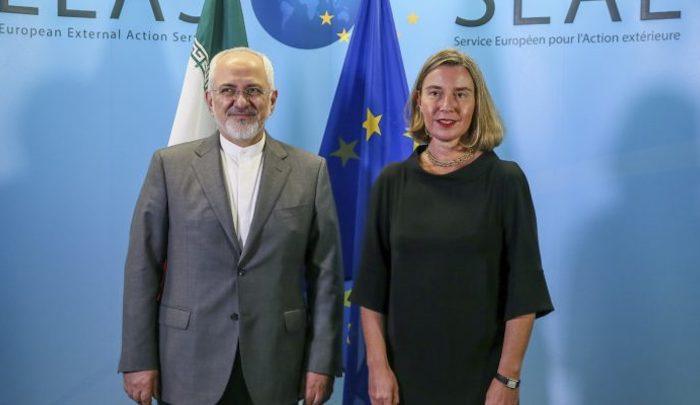
PURGE OF SPEECH ONLY PROVES ALEX JONES WAS RIGHT
BACKLASH WILL BE LIKE THE SURGE OF FIREARM PURCHASES DURING OBAMA'S TYRANNY
BREAKING DOWN THE BLITZKRIEG OF CENSORSHIP AGAINST ALEX JONES & INFOWARS

republished below in full unedited for informational, educational and research purposes:
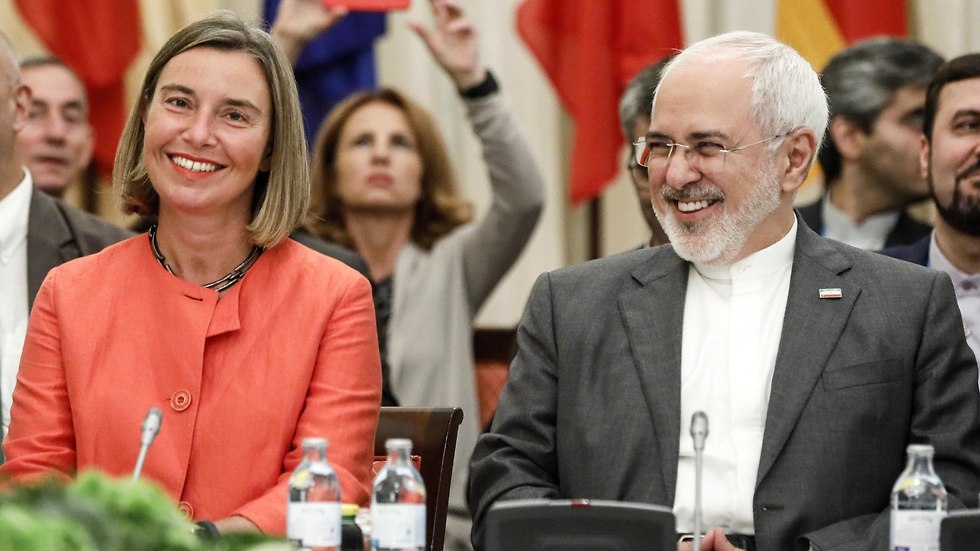
The European Union had a choice between supporting Donald Trump or supporting the leaders of the Islamic Republic of Iran, who scream “Death to America” and “Death to Israel,” aid international jihad terror groups, and brutally oppress their own people. For the EU, it was a no-brainer.“EU slaps Trump in the face, urges ‘increased business with Iran,’” Associated Press, August 7, 2018 (thanks to Inexion):____________________________________________________________________The European Union’s foreign policy chief encouraged companies to do more business with Iran despite new U.S. sanctions, saying Tehran had upheld its commitments under the deal to limit its nuclear program.Federica Mogherini told reporters Tuesday during her trip to Wellington, New Zealand, that it’s up to Europeans to decide whom they want to trade with.“We are doing our best to keep Iran in the deal, to keep Iran benefiting from the economic benefits that the agreement brings to the people of Iran because we believe this is in the security interests of not only our region, but also of the world,” she said. “If there is one piece of international agreements on nuclear non-proliferation that is delivering, it has to be maintained.”The United States reimposed stiff economic sanctions on Iran on Monday, ratcheting up pressure on the Islamic Republic despite statements of deep dismay from European allies, three months after President Donald Trump pulled the U.S. out of the international accord limiting Iran’s nuclear activities.Trump declared that the landmark 2015 agreement was “horrible,” leaving the Iranian government flush with cash to fuel conflict in the Middle East. Trump warned that those who don’t wind down their economic ties to Iran “risk severe consequences.” Business as usual for EU?German car and truck maker Daimler AG on Tuesday said it was suspending its “very limited” activities in Iran. In early 2016 the company announced plans for local truck production and cooperation with an Iranian partner but those plans had not panned out in a weak market. A representative office “will not be continued,” the company said.Iran accused the U.S. of reneging on the nuclear agreement, signed by the Obama administration, and of causing recent Iranian economic unrest.European allies said they “deeply regret” the U.S. action.Trump said in a statement, “We urge all nations to take such steps to make clear that the Iranian regime faces a choice: either change its threatening, destabilizing behavior and reintegrate with the global economy, or continue down a path of economic isolation.”…
Communist and Islamophile Federica Mogherini
MOGHERINI: "POLITICAL ISLAM"IS THE FUTURE OF EUROPESEE OUR PREVIOUS POSTS:EU Foreign Policy Chief Wants European Coast Guardto Protect Migrants SEE: http://ntknetwork.com/eu-foreign-policy-chief-wants-european-coast-guard-to-protect-migrants/; republished below in full unedited for informational, educational, and research purposes:Federica Mogherini said that she is most concerned with migrants’ rights, as Europe has been overwhelmed with foreigners pouring into the continent.



republished below in full unedited for informational, educational and research purposes:
In most developed societies, technology and its devices are readily available and in use for all who will have them. The benefits of this progress have been many. However, there seems to be a dangerous growing epidemic that has been created as a result.Every day we see it in stores, restaurants, and on the streets as we walk — people staring vacantly at the screens in their hands instead of interacting with those around them. And all ages seem to have access to the screens that blind them to the real world around them.What are some of the dangers of this new way of living?Baroness Susan Greenfield, a British research scientist whose work focuses on brain physiology, cautions that social media and video games may create a society of individuals with grossly underdeveloped mental and emotional capacities.In an interview with The Telegraph, Greenfield stated, “What I predict is that people are going to be like three-year-olds: emotional, risk-taking, [with] poor social skills, weak self-identity and short attention spans.” The instant gratification of social media and video games, she asserted, would lead them to need “something every moment to distract them so they can’t have their own inner narrative, their own inner thought process.”As validation of her prediction, the baroness mentioned a recent study by Harvard and Princeton Universities that discovered “students preferred to give themselves an electric shock rather than face 10 minutes alone simply thinking.”Such startling and abnormal findings raise concern for our youth and should bring about action concerning the problem.It is not uncommon for kids to have smart phones well before high school. In fact, according to PsychCentral, “56 percent of children between the ages of 10 to 13 own a smartphone. While that fact alone may come as a shock, it is estimated that 25 percent of children between the ages of 2 and 5 have a smartphone.”The article aptly notes, “It should come as no surprise that smartphones and tablets have now replaced basketballs and baby dolls on a child’s wish list. Elementary school-aged children start asking, or let’s say begging, for these forms of technology before they can even tie their shoes.”The devices, which are created to appeal to increasingly (and astonishingly) younger ages, and the unmonitored and easy access to the Internet can do unfathomable damage to children. Technology is all around us, and as it typically involves face-to-screen time instead of face-to-face time with real people, it promotes isolation — one of its central dangers. This is especially troubling for children and can cause countless side effects — two of which are the inability to interact with others and the inability to self-regulate.In her blog on psychcentral.com, W. R. Cummings states in “The Negative Effects of Technology on Childhood Behavior”:When screen time is idolized, face-to-face time with other people is devalued. Fresh air drops to the bottom of the priority list, and playing (and therefore learning) becomes a backup preference. The ideal overwhelmingly becomes to stare at a screen to be entertained.Children are no longer forced to entertain themselves, but are now able to turn off the active parts of their brain to enjoy themselves. By no fault of their own, they’ve lost a huge piece of their ability to deal with boredom.This cause-and-effect reaction makes learning in the classroom more difficult for kids, which causes frustration, self-doubt, and negative choices. They’re less able to use gained social skills to maintain conversations with their peers. This causes avoidance of peer interaction, inability to express emotion to others, and a desire to escape group activities.The article then addresses one of the same concerns raised by Baroness Greenfield: that of instant gratification:The biggest problem with technology in childhood behavior, however, seems to be the learned expectation that every need or want can be (and should be) met immediately. Instant gratification becomes the norm, instead of the treat.Items can be bought with the click of a button.Packages can arrive on the doorstep in twenty-four hours.Entire seasons of TV shows can be watched in one sitting without having to wait each week for their arrival.Games can be played at faster processing speeds than any toy could compare with.Delaying gratification is a skill that a lot of children are no longer being forced to learn. When a kid can’t have what they want, or what they’re working for, right away, they become overwhelmed. Frustrated. Sad. Upset.To counteract these attitudes, Greenfield suggests that children engage in activities with a beginning, middle, and end. Some examples are reading books, playing sports, and gardening in which the plant growth would not be hurried in contrast to “multi-tasking where everything happens all at once and you can go backward and forward in time in games.”The negative effects of technology on children today are not necessary. If parents take responsibility by gaining knowledge, creating legitimate limitations, and setting right examples, a vibrant childhood does not have to be replaced with a lifeless virtual reality.