Isaiah 5:21-"Woe unto them that are wise in their own eyes, and prudent in their own sight!"
Romans 1:21-32-"Because that, when they knew God, they glorified him not as God, neither were thankful; but became vain in their imaginations, and their foolish heart was darkened. Professing themselves to be wise, they became fools, And changed the glory of the uncorruptible God into an image made like to corruptible man, and to birds, and four footed beasts, and creeping things.
Wherefore God also gave them up to uncleanness through the lusts of their own hearts, to dishonour their own bodies between themselves: Who changed the truth of God into a lie, and worshipped and served the creature more than the Creator, who is blessed for ever. Amen.
For this cause God gave them up unto vile affections: for even their women did change the natural use into that which is against nature: And likewise also the men, leaving the natural use of the woman, burned in their lust one toward another; men with men working that which is unseemly, and receiving in themselves that recompence of their error which was meet. And even as they did not like to retain God in their knowledge, God gave them over to a reprobate mind, to do those things which are not convenient; Being filled with all unrighteousness, fornication, wickedness, covetousness, maliciousness; full of envy, murder, debate, deceit, malignity; whisperers, Backbiters, haters of God, despiteful, proud, boasters, inventors of evil things, disobedient to parents,
Without understanding, covenant breakers, without natural affection, implacable, unmerciful: Who knowing the judgment of God, that they which commit such things are worthy of death, not only do the same, but have pleasure in them that do them."
NEW YORK'S EDUCATED CATHOLIC ELITE WORSHIP THE CREATURE FRANCIS & HIS COMMUNIST AGENDA

FORDHAM UNIVERSITY REFLECTS ON POPE'S CONFLATING OF ATHEIST SOCIALISM/COMMUNISM WITH APOSTATE CATHOLIC "CHRISTIANITY" & APPROVES WITH GLOWING ADORATION
"The Jesuit University of New York Celebrates Pope Francis’ Visit"
SEE: http://news.fordham.edu/faith-and-service/the-jesuit-university-of-new-york-celebrates-pope-francis-visit/; republished below in full unedited for informational, educational, and research purposes:
Millions of eyes were on New York City last week as Pope Francis arrived for the second leg of his three-city visit to the United States. During his brief time in Manhattan the pontiff addressed a wide variety of audiences, ranging from United Nations representatives to third-graders in Harlem.
At Fordham, students from all three campuses gathered to listen to, discuss, and commemorate the historic visit from the first Jesuit pope.
A live viewing at the Lincoln Center campus of the pope’s address to Congress
Papal flags flew and “Pope2Congress” bingo cards were distributed on Sept 24, as members of the Fordham community gathered around televisions on all three campuses to watch Pope Francis address a joint session of the U.S. Congress.
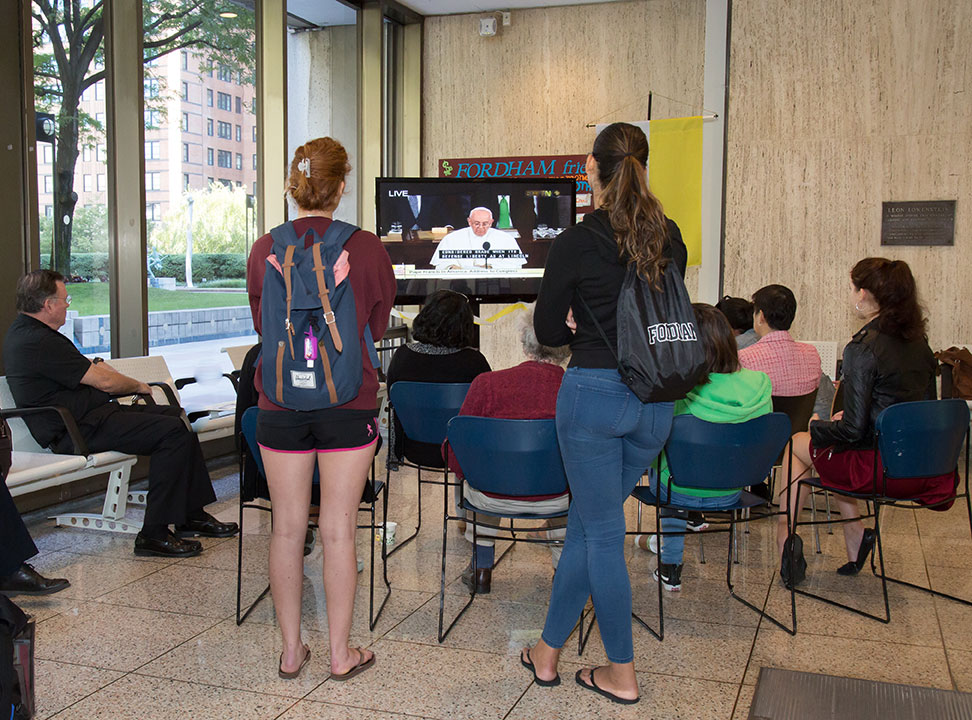
Students watched the live stream of the pope’s address to the U.S. Congress on Sept. 24 on the Lowenstein plaza.
Photo by Patrick Verel
Photo by Patrick Verel
In addition to the lobby in the McGinley Center and Room 228 at the Westchester campus, the address—the first ever for a pope—was broadcast in the plaza-level lobby at the Lincoln Center campus.
The address, in which the pope challenged U.S. leaders on issues such immigration, global climate change, and income inequality, drew both a mix of curious onlookers who lingered at the top of the escalators upon seeing the crowd, and those who listened intently to the hour-long address.
Jamie Saltamachia, FCRH ‘14, GSS ’15, assistant director of the Dorothy Day Center for Service and Justice, was excited that the pope was speaking directly to leaders whose constituents, in many cases, are poor.
“He’s really made an impact on a lot of people and really opened a lot of eyes,” she said.
“People who may have lost their faith years ago are starting to come back to the church, because he is so open minded and has a strong sense of social justice.”
Katie Svejkoski, a first-year English graduate student from St. Louis, said she was pleasantly surprised that Francis called for the abolishment of the death penalty, and was thrilled that he praised Dorothy Day.
“She’s a fabulous lady, and around here she gets lots of credit because we have the Dorothy Day Center But I don’t know that she gets credit in enough areas of the Catholic world or in America in general,” she said.
John J. Shea, S.J. director for Campus Ministry at Lincoln Center, said he found the pope to be very strong in what he wanted to say without being political. And while he was particularly impressed that Francis grouped Thomas Merton with Abraham Lincoln, Martin Luther King Jr., and Dorothy Day as Americans worthy of emulation, he said it was amazing just to see a pope in such a setting.
“We live in interesting times. A pope would never have been invited when I was a boy in high school, when John F. Kennedy was trying to get elected, because they thought the pope would try to run America,” he said.
“Today we see that 30 percent of Congress is Roman Catholic, including the speaker of the house, as are the vice president and more than half of the Supreme Court. It’s all amazing.”
Procession through Central Park
The pope’s second day in New York began with an address to the United Nations, followed by a solemn visit the 9/11 Memorial and Museum in downtown Manhattan. Later that afternoon, the pontiff spoke to elementary school students at Our Lady Queen of Angels School in Harlem before greeting the multitude in Central Park.
At Central Park, where 80,000 New Yorkers won tickets in a lottery to the papal procession, some members of the Fordham community waited in line for nearly three hours to get into the park, as several lines snaked between 60th and 69th streets.
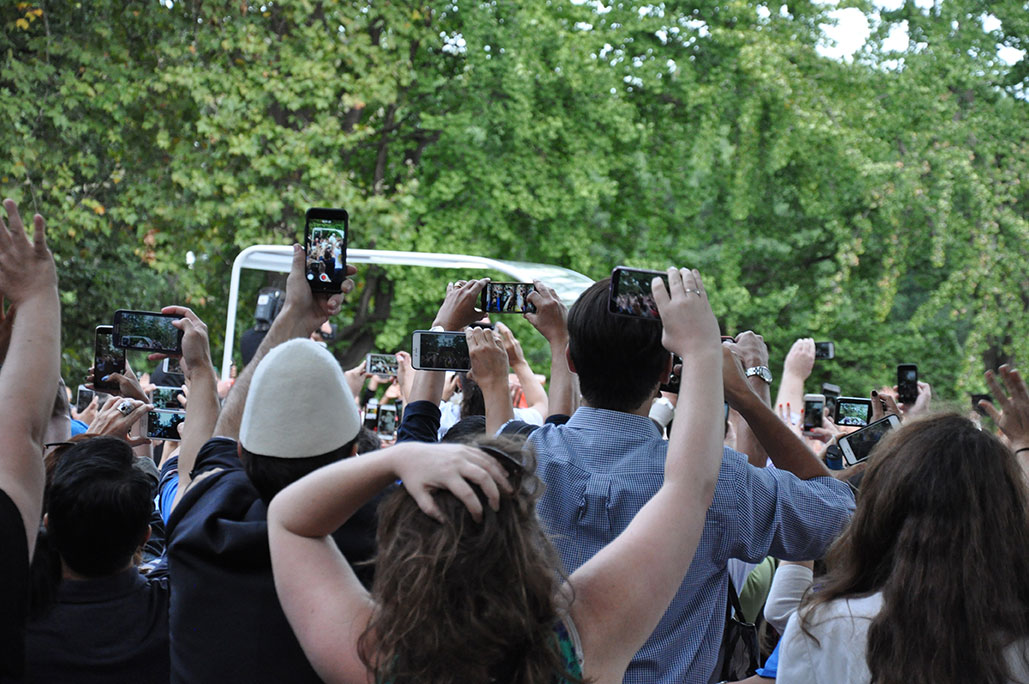
Many watched through cell phones as Pope Francis processed through Central Park on Sept. 25 before some 80,000 people.
Photo by Janet Sassi
Photo by Janet Sassi
Once in the park, Maddy Cunningham, DSW, professor of social work at the Graduate School of Social Service, made a decision to watch the procession rather than try to photograph the pope with her phone as he passed by in his Popemobile.
“I just wanted to see him with my own eyes, to experience the moment,” said Cunningham, who still remembers seeing Pope Paul VI in a procession on Queens Boulevard as a child in 1965. “I am glad I didn’t even try to film [because]he was turned to our side, and he was waving. I now have that image in my mind’s eye.”
Noreen Rafferty, an assistant director in the office of marketing and communications, videotaped the moment when “all the hands went up.”
“It was unbelievable,” she said. “There were so many nationalities—Italian, Irish, Filipino, Puerto Rican. He’s got to come again.”
The Papal Mass at Madison Square Garden
From Central Park, Pope Francis journeyed south to Madison Square Garden, where he celebrated Mass Friday evening with more than 20,000 people.
Despite a three-hour wait and a line that stretched 20 city blocks, the atmosphere outside the arena was one of excitement and conviviality. Strangers befriended one another as they inched closer to the entrance. A group of nuns sang hymns to pass the time. One man broke from the line and ducked into a Duane Reade, returning with a case of water for the wearying pilgrims.

A group of Sisters of Life ordered dinner after waiting in line for hours to enter Madison Square Garden.
Photo by Joanna Mercuri
Photo by Joanna Mercuri
“I was thirsty, and I figured everyone else was, too,” he said as he distributed water bottles down the line.
At 6 p.m. sharp, musicians from St. Patrick’s Cathedral Choir and the New York Archdiocesan Festival Chorale began the processional hymn, and Pope Francis processed into the arena accompanied by bishops, priests, deacons, and seminarians from throughout New York State.
The 90-minute Mass was as international as the crowd itself, with the liturgy alternating between Spanish and English and prayers being offered in Gaelic, Mandarin, French, and Italian. In his homily, Pope Francis spoke in Spanish about the role of faith in cities. Big cities encompass the diversity of life, with their many cultures, languages, cuisines, traditions, and histories. Negotiating this diversity is not always easy, though, the pontiff said. Tragically, our most vibrant cities tend to hide “second-class citizens.”
“Beneath the roar of traffic, beneath the ‘rapid pace of change,’ so many faces pass by unnoticed because they have no ‘right’ to be there, no right to be part of the city,” Pope Francis said from an ambo built especially for the Mass by young men from Lincoln Hall Boys’ Haven.
“They are the foreigners, the children who go without schooling, those deprived of medical insurance, the homeless, the forgotten elderly. These people stand at the edges of our great avenues, in our streets, in deafening anonymity. They become part of an urban landscape which is more and more taken for granted, in our eyes, and especially in our hearts.”
The remedy to our “isolation and lack of concern for the lives of others” is faith, the pope said. We must heed the words of the prophet Isaiah by “learning to see” God within the city, and then go out to meet others “where they really are, not where we think they should be.”
“The people who walk, breath, and live in the midst of smog, have seen a great light, have experienced a breath of fresh air,” Pope Francis said. This light imbues us with a “liberating” hope—“A hope which is unafraid of involvement… which makes us see, even in the midst of smog, the presence of God as he continues to walk the streets of our city.”
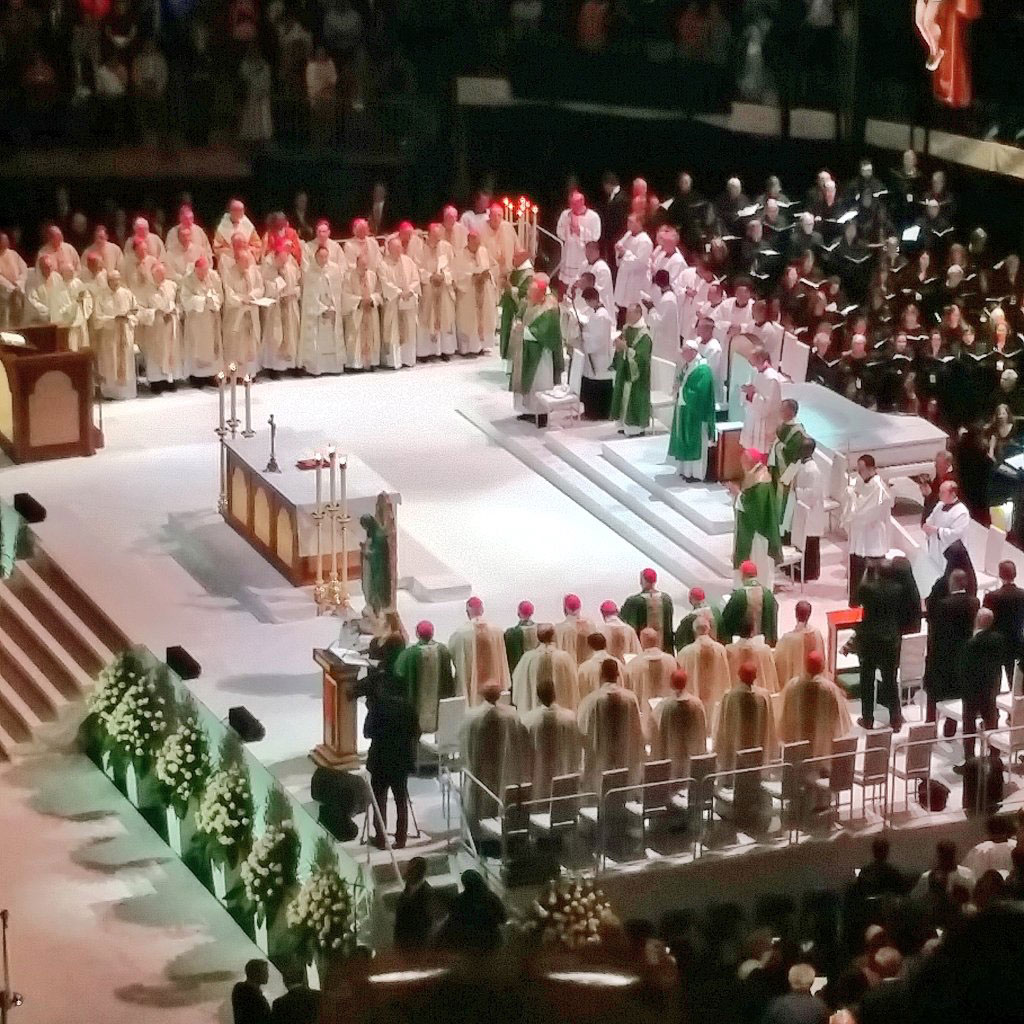
The altar and ambo were constructed by three young men—Frank Corazao, Byron Duran, and Mauricio Agudelo—from Lincoln Hall Boys’ Haven in upstate New York. The pope’s chair was built by Fausto Hernandez, Hector Rojas, and Francisco Santamaria, who are day laborers, in conjunction with Don Bosco Workers, Inc. in Port Chester, NY.
Photo by Joanna Mercuri
Photo by Joanna Mercuri
As the Mass drew to a close, Archbishop of New York Cardinal Timothy M. Dolan offered words of welcome and gratitude to the Holy Father on behalf of New Yorkers.
“Every day and at every Mass, we pray for Francis our pope—and now you here you are!” Cardinal Dolan said, prompting an eruption of cheering and applause throughout the arena—the single display of ebullience amid an otherwise reverent liturgy.
“It is so dazzlingly evident this evening that the Church is our family. Thank you, Holy Father, for visiting us, your family.”
The pope offered a final blessing and before departing, delivered his familiar farewell.
“And please, I ask you—don’t forget to pray for me,” he said.
Fordham Day of Service
On Sept. 26, students and other members of the Fordham community participated in a day of service with Habitat for Humanity-Westchester in honor of the pope’s visit, said Carol Gibney, assistant director of campus ministry. More students showed up than had signed up, she said.
The students worked on refurbishing the Pope Francis house in Yonkers as well as on some other projects in the surrounding area—cleaning an abandoned lot, planting flowers, and laying a brick walkway.

Fordham students volunteered with Habitat for Humanity on Sept. 26 to refurbish the Pope Francis House in Yonkers. They went on to clean up and plant mums in an abandoned lot in a neglected neighborhood nearby.
Photo courtesy of Carol Gibney
Photo courtesy of Carol Gibney
“The area we worked in is one of those communities that are often plagued with violence, crime, and poverty,” said Gibney. “It is one of those communities often forgotten or discarded as ‘worthless’” that Pope Francis spoke about on his U.S. trip.
Once the South Yonkers house is completed in December, it will become the home of U.S. Army Sgt. Michael Velazquez, 24, and his family of six.
“It was a great day for our students as the idea of being men and women for others, particularly by helping to build a house for an Iraqi veteran, a house that is named after the first Jesuit Pope!”
(Patrick Verel and Janet Sassi contributed to this report. Various photographs were submitted by members of the Fordham community.)

"Papal Reflections-Joseph M. McShane, SJ, President of Fordham"

SEE: http://news.fordham.edu/faith-and-service/papal-reflections-joseph-m-mcshane-sj-president-of-fordham/; republished below
in full unedited for informational, educational, and research purposes:
Wednesday, September 23, 2015 | The White House, Washington, D.C.
I rose at 5 and was on line by 6:10. Although the ceremony did not begin till 9:15, the time flew by. How and why?
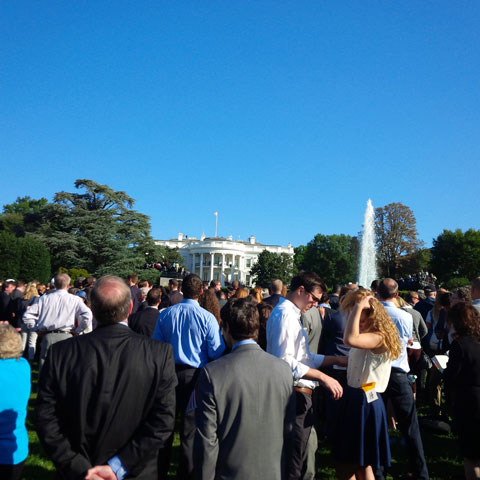
From the White House Lawn.
The crowd was remarkably upbeat. In addition, I ran into many people whom I knew (which was quite a surprise).
The crowd was diverse and spirited—and very, very gracious. Not a cross word was said by anyone in spite of the long wait. When the President and the Pope finally appeared, the already-high spirits of the crowd really soared. The talks were brief but substantive. The President and the Pope are clearly very fond of one another.
I was deeply impressed with the talks that both President Obama and Pope Francis gave. I was even more impressed, however, by the images that will remain with me forever: the images of two principled men of prayer and peace standing side by side before the whole world, the image of two Americans bearing the weight of the world’s sorrows and hopes on their shoulders, the images of a remarkably diverse and hopeful crowd on the lawn of America’s house, the unforgettable sight of the sun rising on a beautiful early fall day over the City of Washington. Most of all, however, I came away with the sense that the President and the Pope have forged a close friendship, a friendship that gives hope to the whole world.
One of the most interesting encounters I had was with a woman who approached me at the end of the Pope’s remarks and asked me if he had blessed the crowd.
Thursday, September 24, 2015 | St. Patrick’s Cathedral, New York, N.Y.
Reflections on this evening’s Vespers Service at the Cathedral. Father Scirghi [Thomas Scirghi, SJ, associate
Reflections on this evening’s Vespers Service at the Cathedral. Father Scirghi [Thomas Scirghi, SJ, associate
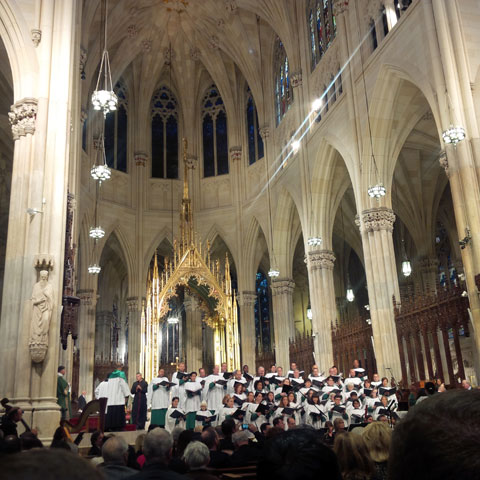
St. Patrick’s Cathedral.
professor of theology and rector of the Jesuit community at Fordham] and I made our way to the Cathedral via Metro North. After making our way through the rather rigorous security check point, we were ushered into the Cathedral and found our way to our seats which were behind a massive pillar on the North Aisle. Alas.
During the three hours before the Pope’s arrival, we were treated to a concert, a lecture on the history of the Papacy, a short presentation on the history of the Cathedral, and the recitation of the rosary.
The recitation of the rosary ended at 6:25, at which time the television monitors in the Cathedral were turned on to keep us up to speed on the Pope’s procession down Fifth Avenue. As you might imagine, the mood in the Cathedral became electric as the Pope got closer. Finally, the great bronze doors at the Fifth Avenue entrance to the Cathedral swung open, the organ swelled, the choir began to sing the anthems that signaled the Pope’s entrance.
Then, something rather strange happened: although the congregation initially burst into thunderous applause when the Pope began to make his way up the main aisle, the applause soon became muted. I was taken aback by the sudden change in the volume of the applause until I realized that people had taken out their cellphones to snap pictures of the Pope as he passed by.
When he reached the sanctuary, the applause swelled again. Then, the mood changed markedly as the Pope disappeared to vest for Vespers. Ah, the Catholic liturgical decorum reigned as the Pope led us through the opening rites of Vespers.
The Pope began his homily with a heartfelt prayer for the Muslim pilgrims who had died earlier that week in Saudi Arabia.
In the body of his homily, he addressed himself to the priests and religious in the congregation. (As he did in St. Matthew’s Cathedral in Washington yesterday, he offered his support to the bishops and the American Church for the pain that they (and we) had suffered as a result of the abuse scandals of the past decade.) The high point of his homily, however, was the praise that he heaped on the religious women whose hard work had built the American Church.
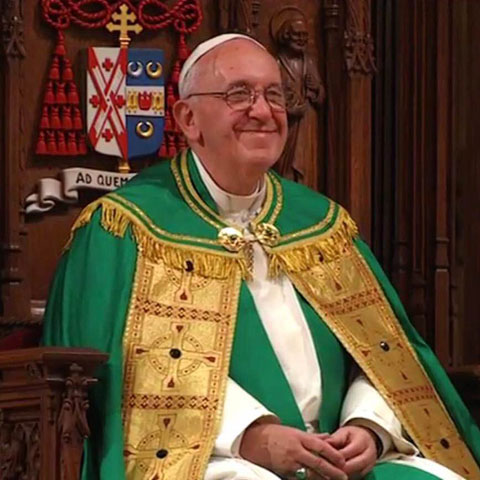
Pope Francis (courtesy of Antonio Spadaro, SJ, editor-in-chief of La Civiltà Cattolica.)the body of his homily, he addressed himself to the priests and religious in the congregation. (As he did in St. Matthew’s Cathedral in Washington yesterday, he offered his support to the bishops and the American Church for the pain that they (and we) had suffered as a result of the abuse scandals of the past decade.) The high point of his homily, however, was the praise that he heaped on the religious women whose hard work had built the American Church.
He was interrupted three times with thunderous applause when he spoke to and about the nuns. As I looked around the Cathedral, I could not help but be struck by the affection that the whole congregation had for these heroic women. I was also deeply moved to see many of the nuns around me crying for joy at the Pope’s words and the applause with which his words were greeted.
Following the conclusion of the Vesper Service, the Pope made his way slowly through the Cathedral, reaching out to the infirm, the young, and the many religious women in the congregation. Then he climbed into his Fiat and sped away.
The congestion dispersed quickly, but with great joy. For my part, I would have to say that I was deeply moved by his miraculous pastoral touch and the obvious love that he had/has for the Church, and the equally obvious love that the entire congregation had for him.
It was an experience of the Church at her best: inclusive, joyful, eager to embrace and transform the world in imitation of the Lord Himself.
Friday, September 25, 2015 | The United Nations, New York, N.Y.
Pope Paul VI was the first Pope to visit the United States and the first to address the General Assembly of the
Pope Paul VI was the first Pope to visit the United States and the first to address the General Assembly of the
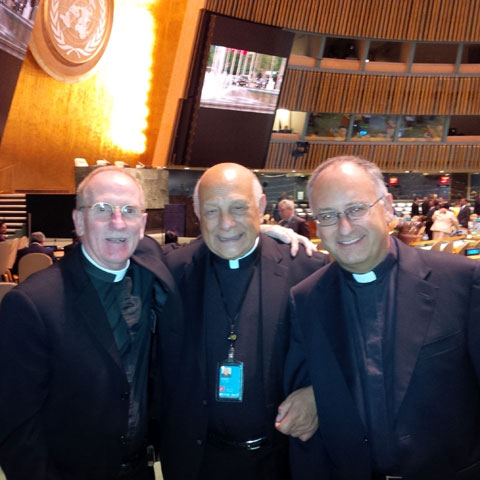
Inside the United Nations
L. to R. Joseph M. McShane, SJ, president of Fordham; Monsignor Hilary Franco, a member of the Papal Nuncio’s staff at the UN; and Antonio Spadaro, SJ, editor-in- chief of La Civiltà Cattolica.
L. to R. Joseph M. McShane, SJ, president of Fordham; Monsignor Hilary Franco, a member of the Papal Nuncio’s staff at the UN; and Antonio Spadaro, SJ, editor-in- chief of La Civiltà Cattolica.
United Nations. He did so on Oct. 4, 1965, the feast of St. Francis of Assisi. I remember that day quite clearly for a number of reasons. First, my father (who was the SAC of New York for the State Department of the United States) served as the federal coordinator of security for the Pope’s visit. Second, I was honored to attend the Pope’s Mass in Yankee Stadium. Third, Paul VI’s address to the General Assembly captivated the world (and continues to be one that I find myself returning to quite often.) Finally, it was an unbelievably cold day, which made the pilgrimage to Yankee Stadium a particularly challenging one.
I guess that it was because my memories of that first papal visit to the United States and that first papal address to the General Assembly of the United Nations are so rich that I looked forward to today with such eager longing.
I rose at 4:45 and caught the 6:00 train to Grand Central. (I noticed that there was only one person awake in Campbell/Conley/Salice at the time that I boarded the train for Manhattan.) When I arrived at the rendezvous spot to which I had been directed by the Nuncio’s staff, I was escorted to the United Nations and whisked through security. (The ease with which I made it through security is probably due to the fact that I was with Cardinal Turkson from both Ghana and the Roman Curia.)
After just a few minutes, I was led into the Assembly Chamber where I found myself in remarkable company:
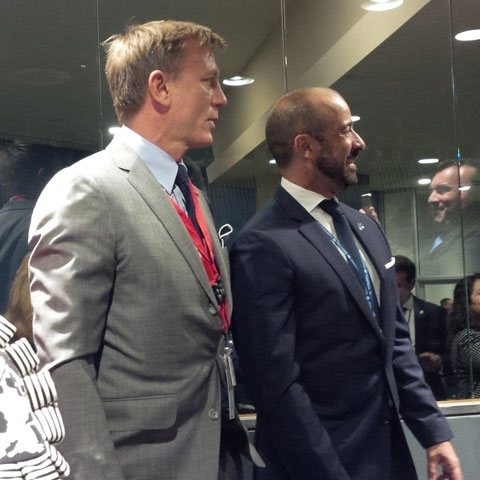
Actor Daniel Craig awaits the Pope at the United Nations.
Daniel (007) Craig, Bill and Melinda Gates, Mayor de Blasio, Commissioner Bratton, Cardinals Dolan, Turkson, and Parolin, two Apostolic Nuncios, the editor-in-chief of the Pope’s newspaper, and the Pope’s press secretary (both of the last two are Jesuits)—and what we were told was the largest of the leaders of states ever to attend the opening session of this General Assembly.
From the moment that the Pope first stepped foot on the UN campus, the television monitors on either side of the speaker’s podium kept us apprised of his progress toward the chamber. When he was finally escorted into the chamber, the entire crowd erupted into applause. (I noticed that the often-photographed Daniel Craig turned into an eager photographer as he snapped picture after picture of the Pope as he made his way to the front of the chamber. James Bond was not the only one taken with the Pope. Far from it. Heads of State whipped out their cellphones to capture the moment forever. And the press corps dropped all pretense of being blasé. They cheered, snapped, and stood on their tip toes with the abandon of Yankee fans—in a good year.)
When he was introduced and began to speak, Francis captivated everyone—from the most seasoned diplomat to the most fervent believer to the most wary critic. His address championed the poor and marginalized, pled for a complete ban on nuclear weapons, and wove together the themes that he wrote of so eloquently in Laudato Si. He was simply extraordinary in all he said. For my part, I was thrilled that he spoke about Paul VI’s visit to the UN 50 years ago, and even more thrilled that he made Paul’s words his own.
Then, it was over. The crowd rose to applaud him. (He was typically quite humble in acknowledging the adulation of the crowd.) And once again, cell phones were whipped out and put to good use to record the event for posterity. (I snapped more than a few myself.)
Friday, September 25, 2015 | Madison Square Garden, New York, N.Y.
Mass in The Garden | A Home Run on a Basketball Court
Mass in The Garden | A Home Run on a Basketball Court
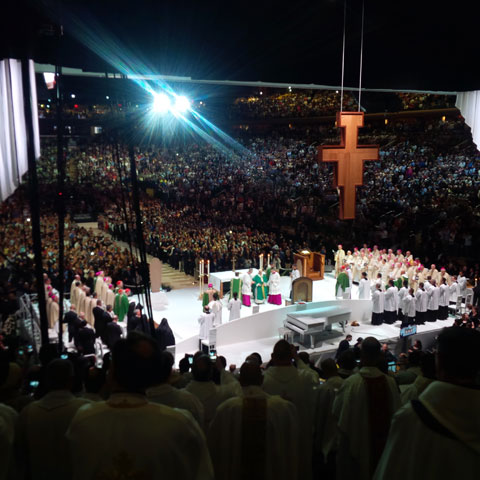
The scene inside Madison Square Garden.
It took hours and something akin to the patience of Job to get into the Garden. (The lines ran all the way south to 23rd Street, down 23rd to 8th Avenue and all the way back up 8th to MSG, perched atop Penn Station.) Every bag, wallet, and belt worn or carried by the 20,000 worshipers was hand-checked.
Once inside, however, the mood of the congregation changed dramatically—and with good reason. The Garden had been transformed from arena to a peculiarly urban cathedral (New-York-style), with subdued lighting and liturgical furniture hand-crafted by local artisans. (The Garden didn’t disappear entirely, however: the concession stands remained open until an hour before Mass began, and the Archdiocese filled the three-to-four-hour period before Mass with a rich mixture of catechesis, entertainment by top-draw performers, and a bilingual recitation of the rosary.)
The long wait came to a close when the Pope arrived ahead of schedule. Once he arrived, he took two turns around the court in an indoor Popemobile. As you might imagine, the crowd roared when they spotted him. Once again, however, the initial applause and cheering eerily ended as people whipped out their cellphones to snap pictures of the Pope as he circled the floor.
Then, he disappeared and the mood turned liturgical-solemn. At least for a while. The opening hymn was properly festive; the readings were proclaimed with a quiet grace. And then Francis walked to the lectern to deliver his homily. He drew the congregation in with a combination of wisdom, humility, and a few savvy nods to the City and its moods and challenges and its quirky joys. The congregation fell under his pastoral spell and roared its loving approval as he preached. (He slyly looked up from his text. And he smiled. And that smile conquered the crowd.) Fortified by the crowd’s enthusiasm, the 78-year-old Pope grew stronger and more animated the longer he preached. Then came his capstone: the Pope assured the congregation that God lived in our City—with all of its challenges, its smogs and fogs, its joys, sorrows and moods (dark and light). That was all it took. The crowd very nearly swooned. They roared their loving approval of both the (papal) preacher and his consoling/challenging message. And the sedate urban cathedral once again became an arena—an arena of grace. What can I say? The soccer fan Pope from Argentina hit a home run on a basketball court (the world’s most famous basketball court at that).
As the Mass continued, the arena once again became New York’s new cathedral. With a nod to the universal
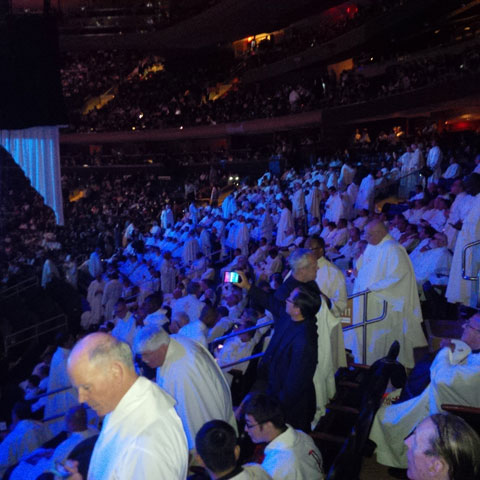
The scene inside Madison Square Garden.
nature of the Church, the Eucharistic prayer was said in Latin, and the Lord’s Prayer was chanted in Latin. A happy chaos reigned at the Kiss of Peace. Twenty thousand souls received Communion. Hymns both ancient and modern were sung with gusto or solemn decorum.
After Communion, Cardinal Dolan rose to thank the Pope for the graces of his visit. The crowd, however, was not going to let the Cardinal speak for them. They interrupted his address with a series of raucous (hey, it was a New York crowd) standing ovations. (I don’t think it would be wide of the mark to say that they were delirious with joy. And they were determined to let their Father in faith know just how much they loved him. It was also clear that they simply didn’t want their moment of grace to end, and that they simply didn’t want to let Francis go.) As for the Pope, it was clear that he was touched and energized by the loving rapport that he had established with his New York flock.
All good things, however, must come to an end. Before he dismissed the congregation, the Pope departed from the solemn cadences of the Roman Rite and looked directly at his brothers and sisters (or were they his sons and daughters) and asked all of them (us) to pray for him.
At that moment, we were all transported back to the scene that unfolded in St. Peter’s Square on the evening on which he was introduced to the world—and asked the vast crowd that had gathered when the white smoke appeared over the Sistine Chapel to pray for him. He need not worry. All who were in the urban cathedral known as MSG will pray for him, the Pope who hit a home run on a basketball court (and the most famous basketball court in the world at that).
I would imagine that the Knicks and the Rangers are jealous tonight. A soccer fan stole the spotlight in their home. And New York embraced a new star. And basked in the love of a Father who called his sons and daughters to live with a new sense of purpose.
________________________________________________________________________________________
http://www.fordham.edu/info/20171/our_story/382/mission_and_history
EXCERPT: "In 2009, the former Community Service Program assumed its current name of the Dorothy Day Center for Service and Justice. This name change was prompted by expansion in the scope of work the office was doing both within the University and the community. To better express its goals and mission, the program renamed itself in honor of Dorothy Day, one of American Catholicism’s foremost social justice leaders."
EXCERPT: "In 2009, the former Community Service Program assumed its current name of the Dorothy Day Center for Service and Justice. This name change was prompted by expansion in the scope of work the office was doing both within the University and the community. To better express its goals and mission, the program renamed itself in honor of Dorothy Day, one of American Catholicism’s foremost social justice leaders."
DOROTHY DAY OF THE CATHOLIC WORKER MOVEMENT (COMMUNIST)

THE CATHOLIC VIEW OF "RADICAL SOCIALIST" DOROTHY DAY
SEE OUR PREVIOUS POST, WITH REFERENCE TO DOROTHY DAY, COMMUNIST:
EXCERPTS: Day was a radical Catholic socialist/communist who advocated the Catholic economic theory of distributism. (SEE:https://en.wikipedia.org/wiki/Dorothy_Day).
